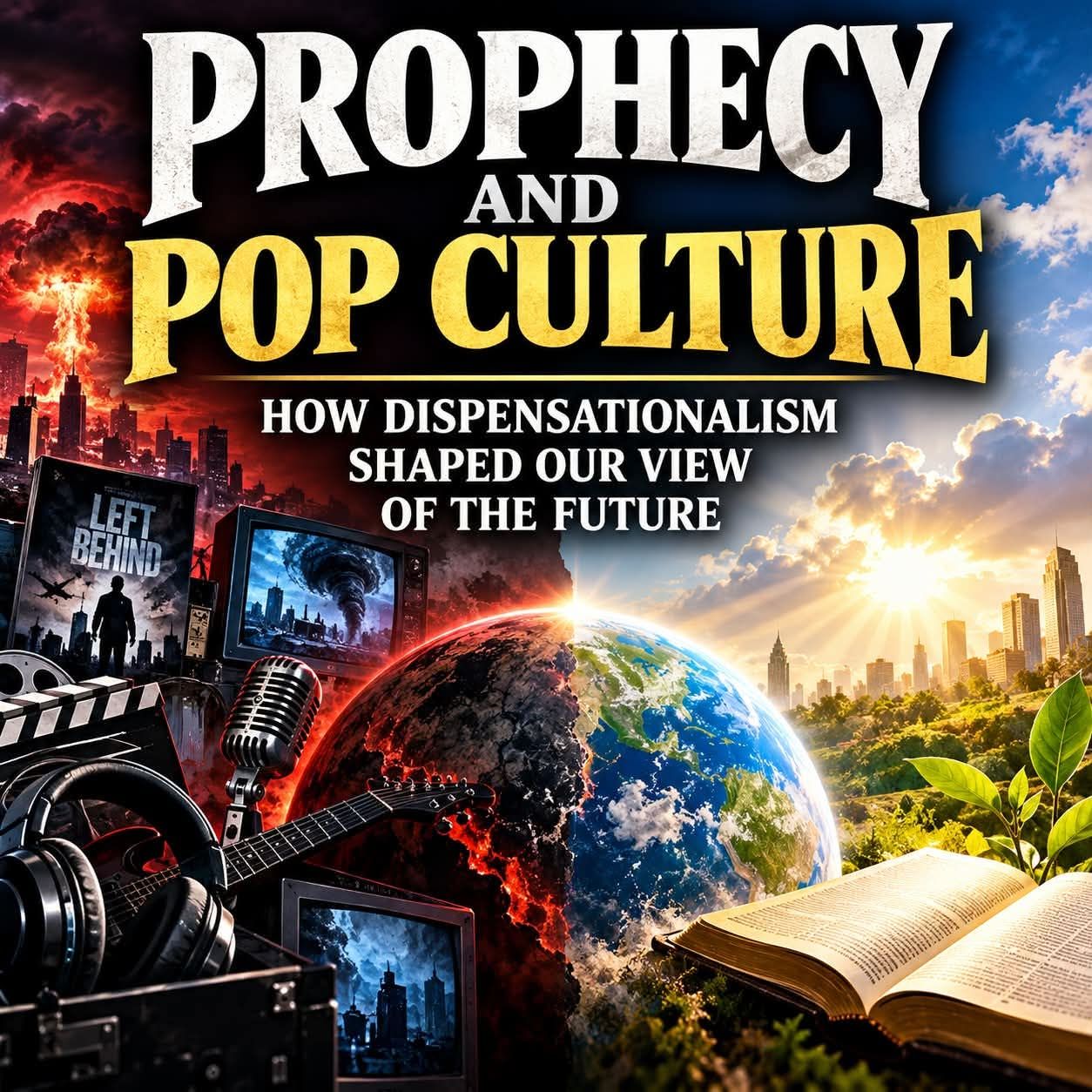
HOW DISPENSATIONALISM SHAPED OUR VIEW OF THE FUTURE
Have you ever stopped to consider how much our understanding of biblical prophecy has influenced the culture around us?
Not long ago, I wrote about the old church hymns many of us grew up singing and how dispensational theology influenced some of those songs. We sang about the rapture, the coming tribulation, and Jesus returning to rescue His people from a world supposedly headed toward destruction.
But then I started thinking about something else.
What about the secular music we grew up listening to? What about the books, television programs, and Hollywood movies that have entertained generations?
Could it be that end-of-the-world thinking became so deeply embedded in our culture that we hardly noticed it?
Some may be too young to remember these songs, and I’m not familiar with much of today’s modern music, but I grew up listening to Creedence Clearwater Revival (CCR). I remember songs like Bad Moon Rising from 1969. John Fogerty sang about earthquakes, hurricanes, and trouble approaching. The song painted a picture of impending disaster.
Then there was Barry McGuire’s Eve of Destruction in 1965. With the Vietnam War, racial unrest, political turmoil, and the threat of nuclear annihilation, people genuinely feared that civilization was approaching its end.
Later came Prince’s 1999 in 1982, reflecting the possibility of nuclear destruction. Then Purple Rain in 1984, with its imagery of blood in the sky.
Remember Europe’s The Final Countdown in 1986? Or R.E.M.‘s It’s the End of the World as We Know It in 1987?
We grew up singing along with these songs, often without stopping to consider the picture they were painting. Many years later, after coming to understand fulfilled theology, I began noticing how closely that atmosphere of impending catastrophe resembled what popular prophecy teaching had been proclaiming for decades.
Think about the atmosphere surrounding those songs.
Now, I’m not suggesting that all these musicians were dispensationalists. But could their songs be directly inspired by a cultural of dispensational theology. There could have been some current cultural influences as well. Much of that music certainly reflected the Cold War, political unrest, nuclear fears, and science fiction.
But here’s what I find fascinating.
While the secular world was singing about impending destruction, much of the church was preaching about destruction on the horizon!
The secular world feared nuclear annihilation. The religious world anticipated Armageddon. The secular world imagined civilization collapsing. The religious world preached about the Great Tribulation and the coming Antichrist.
Different explanations, but often the same expectation.
THE WORLD IS ABOUT TO END!
And dispensationalism helped give that expectation a prophetic storyline.
In 1970, Hal Lindsey published The Late Great Planet Earth, interpreting modern world events through dispensational prophecy. The book became a bestseller and introduced millions to the idea that current events were fulfilling biblical predictions.
Suddenly, people were looking at Russia, Israel, wars, political leaders, and international conflicts as pieces of an unfolding prophetic puzzle.
Then came the 1972 film A Thief in the Night, depicting the rapture and the terrifying events awaiting those supposedly left behind.
And who remembers 1988?
Edgar Whisenant published 88 Reasons Why the Rapture Will Be in 1988.
Think about that! Eighty-eight reasons why Jesus was supposedly returning in a particular year.
And I’ll give you just ONE reason why He didn’t!
Well, 1988 came and went.
But the predictions didn’t stop. Every new generation seemed to discover another reason why the end was just around the corner.
And then came Hollywood!
Remember Armageddon in 1998, starring Bruce Willis? An asteroid threatened to destroy the earth. Interestingly, the movie’s title borrowed a biblical term from Revelation 16:16.
Then there was War of the Worlds with Tom Cruise in 2005, depicting civilization being devastated by an alien invasion.
Other movies such as Independence Day, Deep Impact, 2012, and The Day After Tomorrow presented different scenarios involving the destruction of civilization.
Now, could some of these movies have been influenced by dispensationalism? Certainly! I really believe that the broader cultural atmosphere played a part, although science fiction and disaster stories have their own histories.
But notice how familiar the theme had become.
Humanity is facing destruction. Civilization is collapsing. The world as we know it is coming to an end.
Meanwhile, the Left Behind books and movies brought explicitly dispensational teachings about the rapture, Antichrist, and tribulation directly into popular entertainment.
A huge influence.
A theological interpretation of prophecy had become part of the cultural imagination.
And that brings me to something I believe Christians need to seriously consider.
For generations, much of Christianity has been teaching people to expect the increase of evil, while Jesus described the increase of His kingdom!
Have we become so accustomed to anticipating destruction that we’ve overlooked what Christ actually taught?
I use these Scriptures frequently, but they are profound, and I believe their significance has been overlooked.
Consider the parable of the mustard seed in Matthew 13:31–32.
Jesus described the kingdom beginning small and growing into something much greater.
Again, consider the leaven.
Another parable spake he unto them; The kingdom of heaven is like unto leaven, which a woman took, and hid in three measures of meal, till the whole was leavened.
Matthew 13:33
The leaven was placed in the meal, and its influence continued until the whole was leavened.
I’ve used this analogy lately, and I believe it makes an important point.
Jesus never said the leaven would have to escape because the meal became too corrupt!
He described a kingdom that would spread and transform.
Now compare that with what Isaiah prophesied concerning the Messiah.
Of the increase of his government and peace there shall be no end, upon the throne of David, and upon his kingdom, to order it, and to establish it with judgment and with justice from henceforth even for ever. The zeal of the LORD of hosts will perform this.
Isaiah 9:7
OF THE INCREASE OF HIS GOVERNMENT AND PEACE THERE SHALL BE NO END!
Yet somehow, generations of Christians have become more accustomed to expecting the increase of evil than the increase of Christ’s kingdom.
Let that sink in!
Why?
I believe much of it comes down to how we’ve interpreted biblical prophecy.
Jesus and His apostles were addressing the approaching end of the Old Covenant age. The judgment culminating in Jerusalem’s destruction in AD 70 brought that covenantal order to its conclusion.
They were not predicting the destruction of the physical planet thousands of years later.
Christ’s kingdom was not postponed.
He was already enthroned, and His kingdom was established.
Daniel 2:44 declared that God’s kingdom would never be destroyed.
Paul declared in 1 Corinthians 15:25 that Christ must reign until all enemies were placed beneath His feet.
And Jesus described that kingdom as leaven spreading throughout the whole lump.
Now here’s where I want to take this discussion.
If dispensationalism could influence our books, music, television, and movies with expectations of destruction, why shouldn’t the message of Christ’s victorious kingdom influence those same areas of culture?
Why shouldn’t our music celebrate the increase of His government and peace? I’m already seeing this happen!
Why shouldn’t Christian literature inspire confidence in the reign of Christ? There are great books being published today that are helping turn this thinking around!
Why shouldn’t our filmmakers produce stories reflecting the transforming power of righteousness, truth, and reconciliation? We’re seeing this happen as well!
Why shouldn’t Christians approach education, business, community life, and the arts with the expectation that kingdom principles can make a lasting difference? This is taking place too!
The kingdom’s expansion and advancement are reaching into every crack and crevice of our world and daily lives!
I’m not suggesting evil doesn’t exist or that the world has no problems.
Remember, when Adam and Eve were placed in the garden, the subtle serpent was there as well.
Think about that.
Even in the beginning, in a garden of paradise and bliss, evil was present.
The presence of evil did not mean that God’s purpose for His creation had failed.
And the presence of evil today does not mean Christ’s kingdom is failing!
There’s a tremendous difference between recognizing evil in the world and believing evil is destined to conquer and overpower the world.
For too long, the Christian imagination has been dominated by expectations of destruction.
We have to change that!
I believe it’s time to recover the expectation of victory!
We have spent generations hearing about the increase of evil.
Perhaps it’s time we started talking more about the increase of the kingdom!
Why can’t we center our attention on the good things that are taking place and shine a spotlight on what the kingdom is accomplishing?
We have heard enough speculation about the next Antichrist. Those predictions have repeatedly failed, time after time.
Perhaps it’s time we focused more attention on the Christ who is already reigning!
And instead of raising another generation expecting the world to collapse at any moment, perhaps we should raise a generation that understands the kingdom of God is established, victorious, and continuing to advance.
Yes, for our children, our grandchildren, and generations yet to come!
We should be sounding this message for our posterity and future heirs of the kingdom.
What kind of future are we teaching them to expect?
A world destined for defeat, or a kingdom that continues to increase?
What kind of confidence are we passing down to the next generation?
The kingdom was never an escape plan!
It was established to reign, rule, and transform the nations through righteousness, truth, and peace!
This started at the inauguration in the first century and we are still headed in that direction!
The King is not waiting to be enthroned.
CHRIST REIGNS, AND HIS KINGDOM CONTINUES TO INCREASE!
Yes, if end-of-the-world thinking could influence an entire generation’s music, literature, and entertainment, imagine what the message of Christ’s victorious kingdom could accomplish through those same avenues.
It’s time we started thinking, teaching, creating, and living like we believe it!
I’m passionate about this!
It’s time we think, eat, breathe, and live with the understanding that the everlasting and advancing kingdom is here!
We should explore every opportunity to demonstrate its righteousness, peace, and transforming power in every avenue of our lives and throughout the world.
Not retreating from the world.
Not waiting for an escape.
But living with confidence in the reign of Christ and the advancement of His everlasting kingdom!
And I want to close with this beautiful prophecy from Habakkuk.
For the earth shall be filled with the knowledge of the glory of the LORD, as the waters cover the sea.
Habakkuk 2:14
THE KINGDOM IS ADVANCING.
THE KING IS REIGNING.
AND THE KNOWLEDGE OF HIS GLORY SHALL FILL THE EARTH AS THE WATERS COVER THE SEA!


You must be logged in to post a comment.