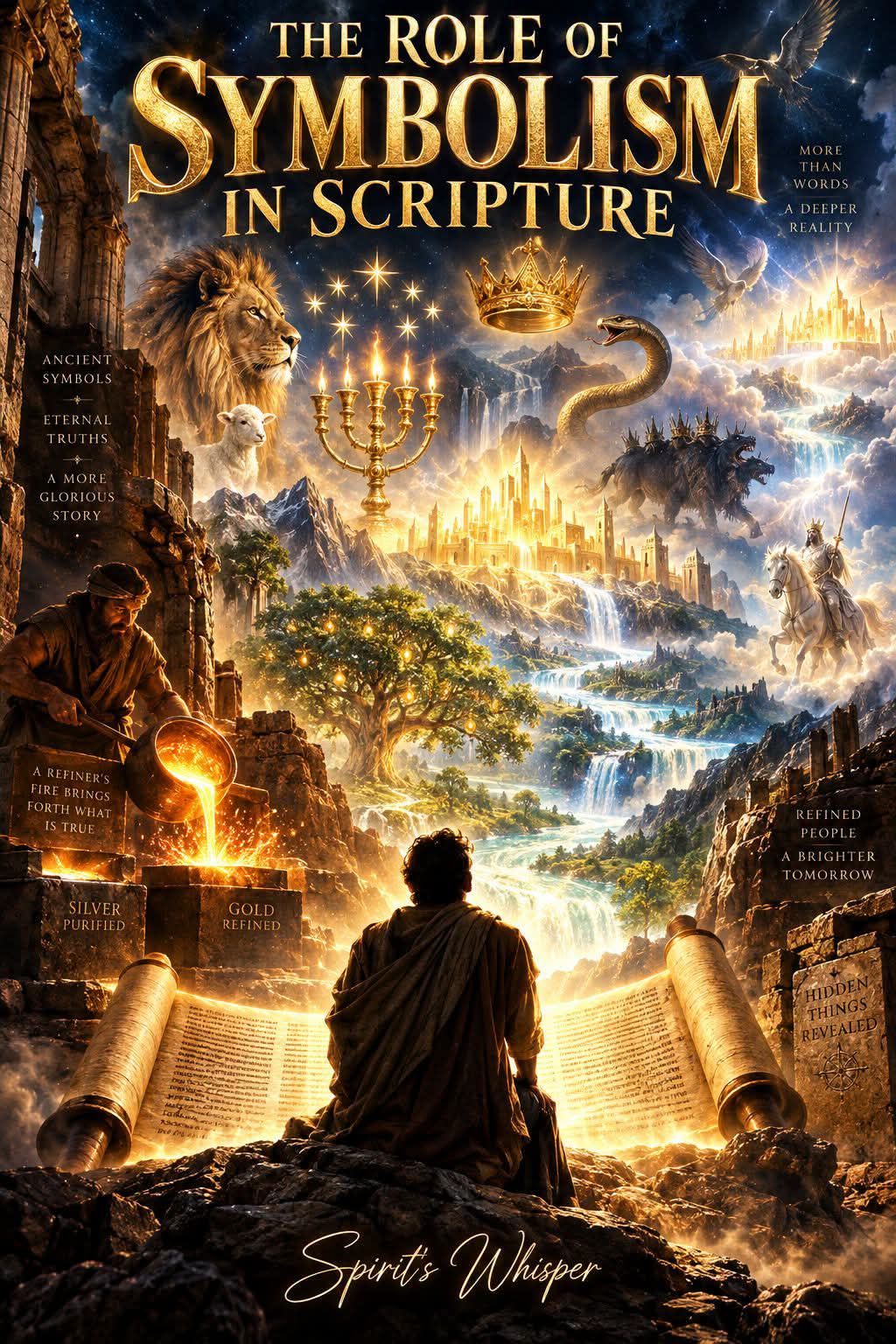
One of the greatest mistakes we can make when reading Scripture is assuming that ancient people heard its images exactly the way a modern Western reader hears them.
We flatten symbols into photographs.
We take poetry and turn it into journalism.
We take prophetic imagery and turn it into a literal description of future geography.
And sometimes we take imagery that ancient people associated with purification, transformation, kingdoms, temples, and metallurgy—and reduce it to nothing more than descriptions of endless torture.
But Scripture was born in a world of symbols.
The people hearing these writings understood vineyards, threshing floors, shepherds, furnaces, refining pots, lamps, temples, sacrifices, beasts, stars, mountains, seas, gold, silver, bronze, iron, fire, and smoke in ways that many modern readers simply do not.
Their world supplied the vocabulary of the revelation.
Consider metalworking.
To an ancient person, fire did not merely mean destruction.
Fire revealed what something was made of.
Ore entered the furnace mixed with impurities.
Heat exposed it.
What could not remain was separated.
What was valuable survived the process.
This is why Scripture can say:
“He will sit as a refiner and purifier of silver.”
— Malachi 3:3
Notice the picture.
The refiner does not hate the silver.
He heats the silver because he values it.
The fire is directed against what does not belong in the silver—not against the silver itself.
Isaiah uses similar language:
“I will turn my hand against you; I will thoroughly purge away your dross and remove all your impurities.”
— Isaiah 1:25
The hand that judges is also the hand that purifies.
The fire removes the dross.
Even Numbers speaks of metals being passed through fire and becoming clean.
So when an ancient biblical audience encountered furnaces, molten metal, fire, gold, silver, bronze, smoke, and refining, they already possessed an entire symbolic vocabulary surrounding purification and transformation.
That matters tremendously when we arrive at Revelation.
Revelation is perhaps the most symbol-saturated book in the New Testament.
A Lamb has seven horns and seven eyes.
Stars are held in a hand.
Lampstands represent churches.
A dragon attempts to devour a child.
A woman is clothed with the sun.
A beast rises from the sea.
Another beast rises from the earth.
Babylon becomes a woman.
A sword comes from Christ’s mouth.
Death rides a horse.
Hades is ultimately thrown into a lake of fire.
Almost nobody reads every one of these images literally.
Yet strangely, when we reach the fire, many suddenly abandon symbolism completely.
Everything surrounding the fire can be symbolic—
but the fire must become a literal cosmic torture chamber.
Why?
Revelation itself tells us repeatedly that we are entering a world of signs.
John is seeing truth communicated through images.
And those images did not originate in a vacuum.
They draw heavily from Daniel, Isaiah, Ezekiel, Zechariah, Exodus, the Psalms, temple worship, empire, agriculture, warfare, and the refining furnace.
Revelation 14 even describes judgment using “fire and sulfur.”
To modern ears, sulfur immediately sounds like hell.
To ancient ears it could evoke something broader: burning, judgment, furnaces, and the terrifying heat associated with the transformation of material.
Ancient smelting was one of the few human activities where people regularly witnessed stone-like ore enter intense fire and something entirely different emerge.
The furnace became an extraordinary picture of transformation.
The prophets had already used that picture spiritually long before Revelation was written.
“I have refined you, though not as silver; I have tested you in the furnace of affliction.”
— Isaiah 48:10
The furnace is affliction.
The metal is the person.
The refining is transformation.
The imagery interprets itself.
Peter continues the same symbolic world:
“Your faith—of greater worth than gold, which perishes even though refined by fire—may be proved genuine.”
— 1 Peter 1:7
And Paul says:
“The fire will test the quality of each person’s work.”
— 1 Corinthians 3:13
Then comes one of the most fascinating lines:
“If it is burned up, the builder will suffer loss but yet will be saved—even though only as one escaping through the flames.”
— 1 Corinthians 3:15
Fire destroys something.
Yet the person comes through it.
That should at least cause us to reconsider the assumption that every biblical fire automatically means God endlessly torturing someone.
Sometimes biblical fire consumes.
Sometimes it judges.
Sometimes it exposes.
Sometimes it purifies.
Sometimes it tests.
Sometimes it represents the presence of God Himself.
“Our God is a consuming fire.”
— Hebrews 12:29
Perhaps the question is not merely:
“Who gets thrown into the fire?”
Perhaps another biblical question is:
“What cannot survive when everything false encounters God?”
Paul says:
“Each one’s work will become manifest, for the Day will disclose it, because it will be revealed by fire.”
What if much of the imagery we have been taught to fear externally was intended to reveal something internally as well?
The beast.
Babylon.
The false prophet.
The dragon.
The mark.
The furnace.
The lake of fire.
Could these images also reveal systems, identities, desires, empires, false selves, and structures opposed to the nature of Christ?
Notice something astonishing near the end of Revelation:
Death itself is thrown into the lake of fire.
How do you literally burn death?
Death is not a physical object.
Neither is Hades.
Yet Revelation says:
“Then death and Hades were thrown into the lake of fire.”
— Revelation 20:14
The imagery is communicating the destruction of death itself.
That sounds remarkably close to Paul:
“The last enemy to be destroyed is death.”
— 1 Corinthians 15:26
And when death is finally gone, Revelation does not end with darkness winning half of creation.
It ends with renewal:
“Behold, I make all things new.”
— Revelation 21:5
There is a river.
There is a tree.
There are leaves.
And strangely, those leaves are said to be:
“for the healing of the nations.”
— Revelation 22:2
Healing.
After judgment.
That is worth noticing.
Symbolism does not weaken Scripture.
Symbolism deepens it.
A symbol can carry layers of meaning that literal description cannot contain.
The serpent can reveal deception.
Egypt can become bondage.
Babylon can represent empire.
The wilderness can become testing.
Water can become cleansing.
Bread can become life.
Wine can become covenant.
The temple can become humanity.
Circumcision can become something occurring in the heart.
Jerusalem can become something “above.”
Fire can become judgment and purification.
Gold can become what remains after testing.
And resurrection can become not only something proclaimed about Jesus, but a pattern of dying and rising that the believer participates in.
This is how biblical imagination works.
The visible points toward the invisible.
The outer reveals the inner.
The earthly becomes a language for the spiritual.
Jesus Himself taught this way constantly.
Seeds.
Soil.
Trees.
Bread.
Water.
Fish.
Pearls.
Vineyards.
Weddings.
Lamps.
Children.
Birth.
Death.
Resurrection.
He was teaching people to see beyond the object into the reality toward which the object pointed.
Perhaps Scripture has not been too mysterious.
Perhaps we have been too literal.
We inherited explanations centuries removed from the agricultural, prophetic, temple, and metallurgical world in which these texts were formed.
Then we assumed our interpretation was simply “what the Bible says.”
But returning to the ancient world can reopen the language.
The furnace becomes more than torture.
The fire becomes more than fear.
The metal becomes more than metal.
The temple becomes more than a building.
And Revelation becomes more than a timetable for destruction.
It becomes revelation—
an unveiling.
The unveiling of what is false.
The unveiling of what cannot endure.
The unveiling of Christ.
And perhaps even the unveiling of what remains when everything in us that was never eternal has finally passed through the fire.
Look beyond the letter.
Listen beneath the image.
The symbol is not hiding the truth.
It is inviting you deeper into it.


You must be logged in to post a comment.