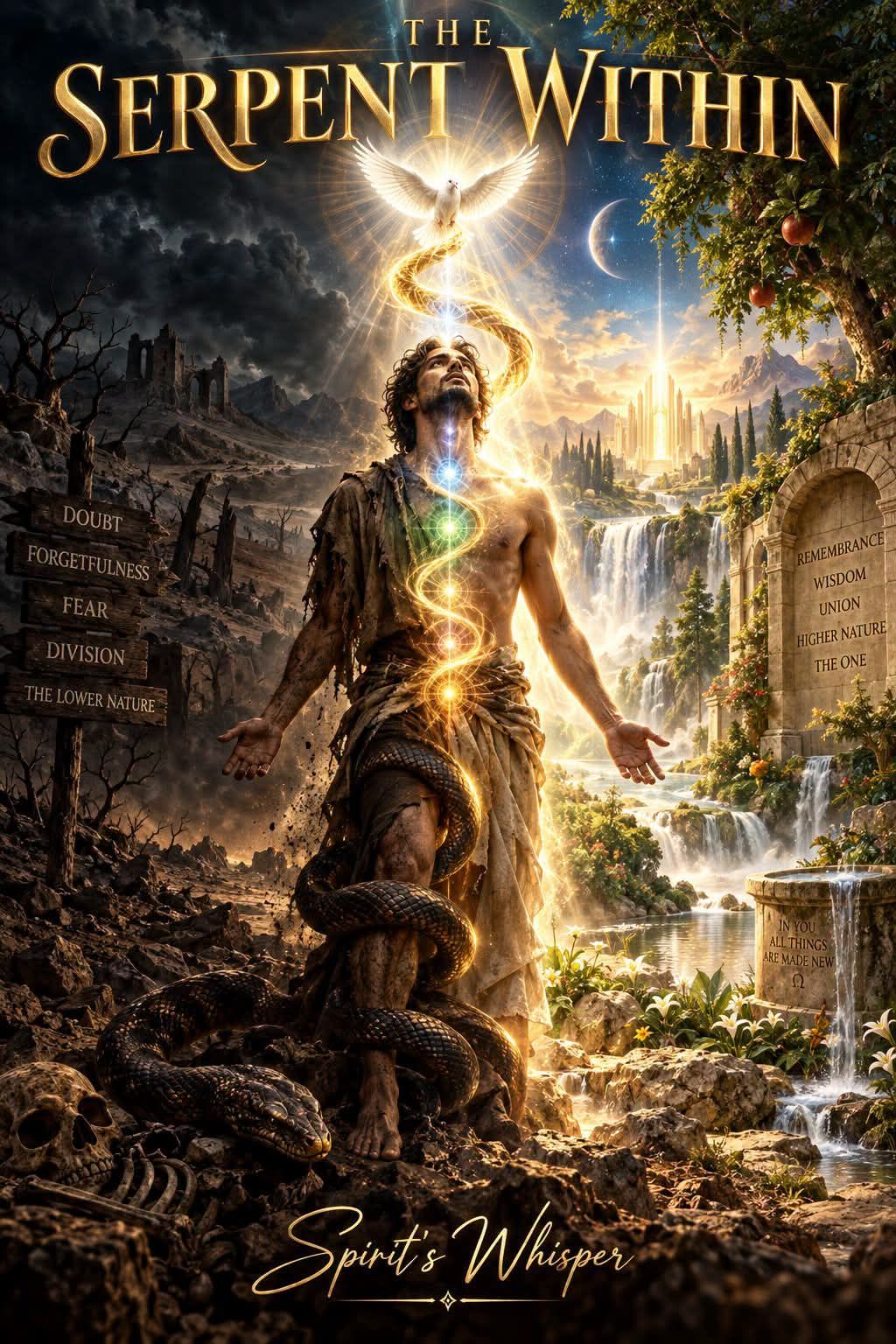
When scripture speaks of the serpent, perhaps the first mistake is imagining only an animal outside of us.
For the serpent asks a question that still rises in the human mind:
“Did God really say?”
That voice has never disappeared.
It is the voice within that doubts what God has spoken over us.
The voice that says:
Are you really loved?
Are you really whole?
Are you really a son?
Are you really made in the image of God?
Is the Kingdom really within you?
Can you really trust what is written upon the heart?
This is the serpent within.
Not necessarily an outside creature whispering from behind a tree, but the lower nature of consciousness that questions identity, divides what was whole, and causes remembrance to become forgetfulness.
The serpent begins with doubt.
“Did God say?”
And once identity is doubted, separation follows.
Suddenly the one who walked naked and unashamed begins hiding.
Suddenly innocence becomes self-consciousness.
Suddenly union becomes fear.
The garden does not merely disappear geographically.
It disappears psychologically.
Man leaves Eden the moment he forgets who he is.
And perhaps that is why the serpent is such an ancient symbol across cultures.
In India, serpent imagery appears in kundalini traditions, where coiled energy is pictured at the base of the body and rises through the centers of consciousness.
In ancient Egypt, the cobra could symbolize both danger and awakened royal power.
In Greek symbolism, serpents appear around healing, medicine, renewal, and transformation.
The serpent sheds its skin.
It dies to an old covering and appears renewed.
So the serpent is not a simple symbol.
It can represent wisdom.
Power.
Instinct.
Healing.
Life force.
But when consciousness remains low, that same force becomes appetite without understanding, fear without discernment, and desire without remembrance.
That is the lower serpent.
The energy itself may not be evil.
The question is:
What governs it?
The flesh?
Fear?
Ego?
Or Spirit?
This is why the serpent in Eden can be understood as the downward movement of consciousness into division.
The mind begins interpreting reality apart from union.
It judges.
It grasps.
It compares.
It becomes aware of opposites.
Good and evil.
Mine and yours.
Sacred and profane.
Us and them.
And suddenly the tree of knowledge becomes the tree of fragmentation.
The serpent says:
Look outward.
Question your origin.
Doubt your identity.
Become something.
But God had already declared what man was.
Made in the image.
Breathing Divine breath.
Living in union.
The temptation was not merely to eat fruit.
It was to forget.
And this is why spiritual awakening is remembrance.
Paul says:
“Be ye transformed by the renewing of your mind.”
Because the serpent first works in the mind.
And Christ restores the mind.
The carnal mind says:
You are separate.
Christ says:
“I and my Father are one.”
The carnal mind says:
You are condemned.
Christ says:
“Neither do I condemn thee.”
The carnal mind says:
You must become worthy.
Christ reveals the image that was there before fear taught you otherwise.
And then scripture gives us an even stranger image.
Moses lifts up the serpent in the wilderness.
The very image associated with the wound becomes the thing people must look upon.
Jesus later says:
“As Moses lifted up the serpent in the wilderness, even so must the Son of man be lifted up.”
Why would the serpent be lifted?
Perhaps because what lives in the lower realm must be raised into higher consciousness.
Instinct must become wisdom.
Fear must become awareness.
Desire must become love.
The lower nature must be brought into the light.
Nothing heals by remaining hidden.
The serpent is lifted because what was unconscious must become conscious.
What crawled upon the ground must rise.
What lived in the dust must be transfigured.
And suddenly the serpent becomes more than an enemy.
It becomes an image of the very thing within us that must be redeemed.
This is also why Jesus tells His disciples:
“Be wise as serpents, and harmless as doves.”
Notice He does not say:
Have nothing to do with serpent wisdom.
He says:
Take the wisdom—
but marry it to innocence.
Power without love becomes manipulation.
Knowledge without purity becomes ego.
Instinct without Spirit becomes appetite.
But wisdom united with the dove becomes awakened consciousness.
The serpent and the dove.
Earth and heaven.
Instinct and Spirit.
Lower nature and higher nature brought into alignment.
The problem is not that you possess a lower nature.
The problem is when you believe it is your identity.
The serpent says:
You are your fear.
You are your appetite.
You are your shame.
You are your thoughts.
You are your wounds.
You are your separation.
But Christ reveals something deeper.
You are not the voice asking, “Did God say?”
You are the one who can hear that voice and refuse it.
You are the one who can remember.
You are the one who can rise.
You are the one in whom the image of God remains.
The serpent crawls in the dust.
And dust in scripture often represents the lower earthly nature.
But man was not formed from dust alone.
God breathed into the dust.
And the dust became alive.
That breath is what the serpent wants you to forget.
Your origin is not merely earth.
Your origin is breath.
Spirit.
Presence.
Life.
So perhaps the story of the serpent is not primarily about blaming an animal in an ancient garden.
Perhaps it is about recognizing the voice within that keeps inviting us to abandon what God has already spoken.
“Did God say?”
Yes.
God said you bear the image.
God said the Kingdom is within.
God said His Spirit has been poured out.
God said you are His offspring.
God said love fulfills the law.
God said light shines in the darkness.
The serpent asks you to doubt your origin.
Christ calls you to remember it.
And awakening begins when the old question,
“Did God say?”
no longer fills you with doubt,
but becomes the doorway back to remembrance:
I was never abandoned.
I was never without the breath.
I was never outside the image.
What was buried in dust
has remembered how to rise.
The serpent whispers doubt.
The lower nature forgets.
Christ restores remembrance.
Rise from the dust and remember the breath.


You must be logged in to post a comment.