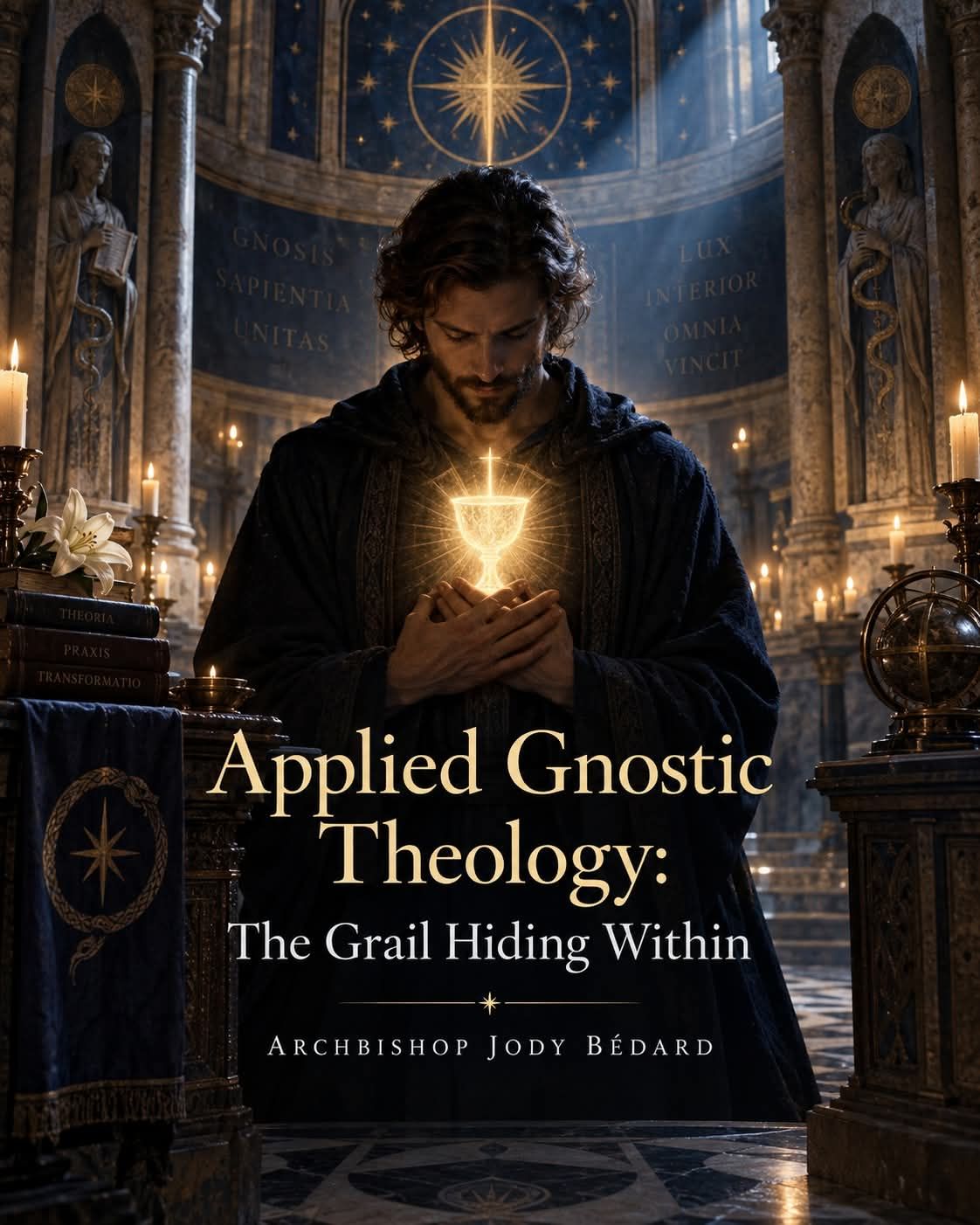
For centuries, the Holy Grail has been imagined as something hidden in the world. It has been described as a cup, a relic, a bloodline, a vessel of sacred blood, or a secret preserved by kings, monks, knights, and initiatory orders. These traditions may preserve fragments of history, symbolic memory, or spiritual teaching, but Applied Gnostic Theology asks a more immediate question. What if the Grail was never intended to remain an external object of search? What if the Grail was always a symbol of the human being who becomes capable of receiving, containing, and embodying Gnosis?
The first significance of the Grail is that it is a vessel. A vessel receives, co
ntains, preserves, and pours forth what has been placed within it. In spiritual terms, this makes the Grail an image of transformed consciousness. Human beings begin life filled with inherited identities, cultural assumptions, fears, desires, wounds, expectations, and the voices of external authorities. We are told who we are long before we possess the awareness necessary to determine whether those identities are true. The Gnostic path begins when the individual turns inward and begins separating what has been imposed upon the self from what arises from the deeper Self.
This process is not simply intellectual. Gnosis is not the accumulation of religious information. It is recognition. The seeker gradually discovers that the divine spark was not absent, but concealed beneath layers of unconscious identification. The spiritual task is therefore not to import divinity into the human being from somewhere outside. It is to remove what prevents the divine image from being recognized. In this sense, the Grail is hidden because the true nature of the person is hidden. The sacred vessel has always been present, but it remains unknown until consciousness turns inward.
This interior interpretation also helps explain one of the most persistent themes in Grail literature: the wounded king and the wounded land. The condition of the kingdom reflects the condition of its ruler. Psychologically, this is a profound image. When fear governs consciousness, the world becomes threatening. When resentment rules, every interaction becomes another injury. When desire rules, nothing is sufficient. When the ego rules, identity becomes dependent upon approval, reputation, status, possession, and comparison. Applied Gnostic Theology therefore asks a practical question: who is sitting upon the throne of consciousness?
The Grail quest becomes transformative when the seeker stops asking only where the sacred object is hidden and begins asking what governs the interior kingdom. A wounded consciousness produces a wounded world because the individual interprets reality through the ruler who occupies the inner throne. The restoration of the kingdom begins when the false ruler is recognized. This is where Gnostic theology becomes applied rather than merely speculative. The seeker is not asked simply to believe that transformation is possible. The seeker must identify the forces that actually govern thought, behavior, attachment, fear, and identity.
Many Grail narratives also turn upon the asking of the correct question. This detail is more than literary ornament. Genuine transformation begins when consciousness becomes capable of questioning the structures that previously remained invisible. Who am I beneath my roles, achievements, failures, titles, wounds, possessions, and social identity? What within me observes my thoughts rather than merely producing them? What remains when the identities given to me by family, culture, profession, and religion are stripped away? Gnosis begins when the individual stops assuming that the constructed personality is the whole person.
The Gospel of Philip offers another important lens through its symbolism of the bridal chamber. In Gnostic thought, separation is one of the deepest conditions of human suffering, while reunion represents restoration. The divided person becomes whole. What was separated is reconciled. The visible self encounters the hidden self, the earthly image recognizes its heavenly likeness, and the fragmented psyche begins to recover its unity. Read alongside Jungian individuation, the symbolism is striking. The work of transformation requires the conscious person to confront, integrate, and reconcile those aspects of the self that have been denied, projected, feared, or left unconscious.
The Grail can therefore be understood as the vessel in which this reconciliation occurs. It is not merely an object held by the seeker. It represents the seeker transformed into a vessel capable of holding opposing realities without fragmentation. Conscious and unconscious, spirit and matter, masculine and feminine, suffering and meaning, mortality and divine image are no longer experienced only as contradictions. They become dimensions of a larger wholeness. The Grail is sacred because it represents the capacity to contain what the untransformed personality cannot yet hold.
The Christian Grail tradition eventually connected the vessel to the blood of Christ. Within Applied Gnostic Theology, this image can be read as more than the preservation of physical blood. Blood symbolizes life. To receive the blood of Christ is therefore to participate in the pattern represented by the Christ life. It is a movement through the death of false identity, descent into darkness, confrontation with the powers that govern the divided self, recognition of divine origin, and emergence into a transformed mode of being. Christianity then becomes participation rather than spectatorship.
This distinction matters. If Christ remains only an external figure to admire, worship, or imitate, the believer can remain fundamentally unchanged. But if the Christ pattern describes a transformation that must occur within the individual, then the entire meaning of the spiritual life shifts. The question is no longer simply whether one believes in resurrection. The question becomes whether something within the person has actually undergone resurrection. Has the false ruler lost the throne? Has the divided self begun to become whole? Has the divine image become recognizable within consciousness?
The Grail, understood this way, was never truly lost. Humanity became estranged from the interior reality the symbol represented. We searched outward for the sacred because we had forgotten how to recognize it inwardly. Religious institutions, sacred objects, pilgrimage sites, legends, bloodlines, rituals, and mysteries may all preserve pieces of the pattern, but they remain incomplete if they do not lead the seeker back toward transformation.
The deepest Grail teaching may therefore be remarkably simple. The sacred vessel is not valuable because of what it once contained. It is valuable because of what it is capable of containing. The same is true of the human being. Gnosis awakens when the person becomes capable of receiving a greater reality without reducing it to dogma, fear, identity, or possession. The Grail is discovered when the seeker becomes the vessel.
This is the practical work of Applied Gnostic Theology. The task is not merely to search for hidden knowledge, but to become capable of bearing it. It is not merely to study resurrection, but to undergo the transformation that resurrection signifies. It is not merely to seek the Kingdom, but to restore the interior kingdom by returning the true Self to the throne of consciousness.
Perhaps this is why the Grail has remained such a powerful symbol across centuries. It points toward something that cannot be completed by archaeology, genealogy, or religious belief alone. The final discovery is interior. The Grail we seek may have been hidden within us all along, waiting for the false self to become quiet enough for the sacred vessel to be recognized.
With you as the chalice, the heart, or the supporting mind of experienced gnosis upon your path…


You must be logged in to post a comment.