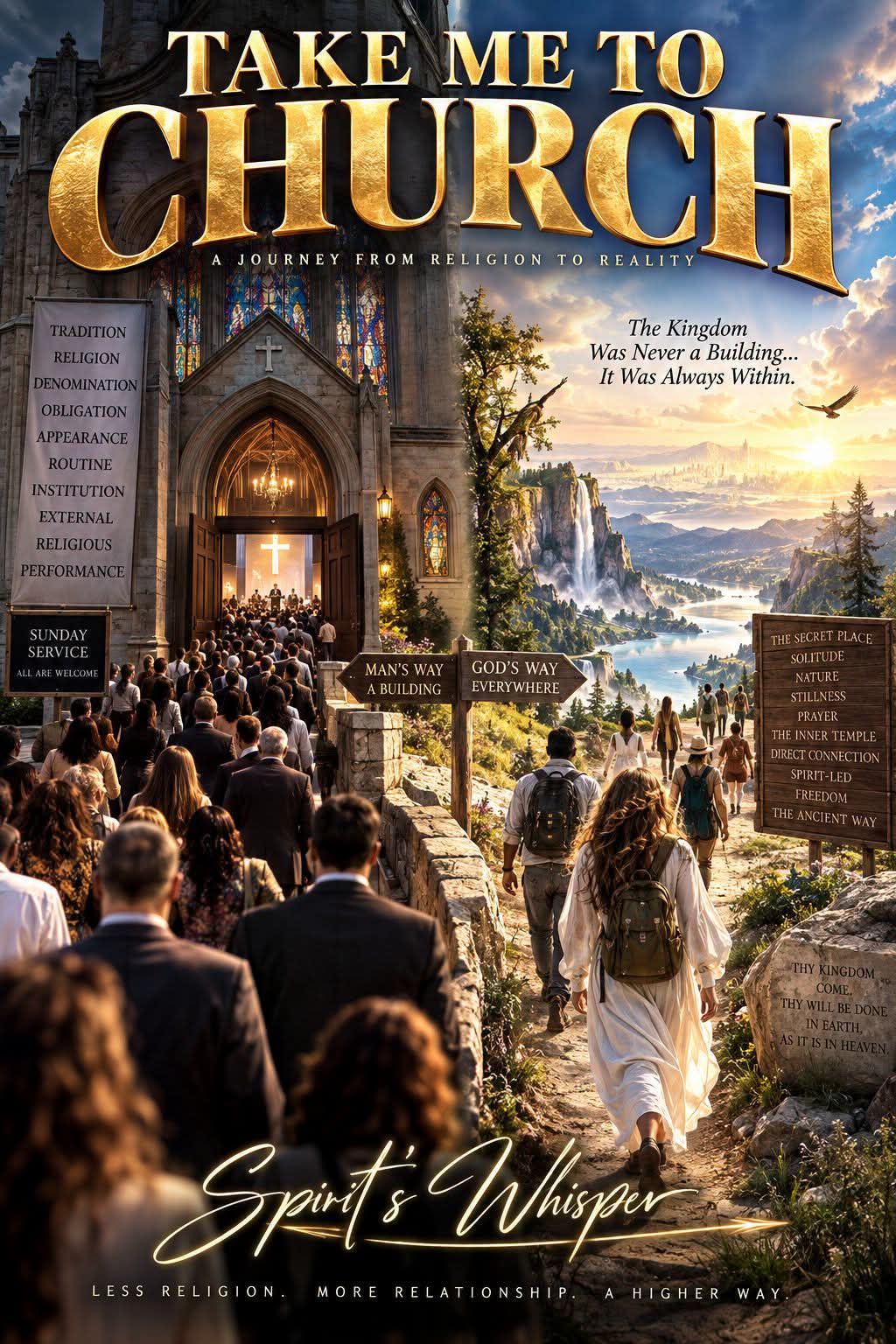
Today, millions upon millions of “believers” will go to church.
They will get dressed, drive to an institutional building, sit in a pew, sing songs, listen to a sermon, give an offering, shake a few hands, and leave believing they have done something for God.
Some will genuinely be led there by the Spirit.
Some will go because their heart desires fellowship.
But many will go for one simple reason:
It is what they have always done.
Tradition has a powerful way of convincing us that repetition is obedience.
For forty years, I knew that world.
You go to church.
You give your money.
You sing about Jesus.
You hear about Jesus.
You study Jesus.
You wait for Jesus.
And somewhere along the way, you can spend your entire life talking about Christ while never actually following the instructions He gave you.
Jesus said:
“When thou prayest, enter into thy closet.”
He continually withdrew from crowds.
He went into solitary places.
He taught that the Kingdom was within and among us.
He taught that worship would no longer ultimately be about this mountain or that mountain, but Spirit and truth.
Yet somehow we built a religion that continually points the human being outward.
Find the right building.
Find the right pastor.
Find the right denomination.
Find the right conference.
Find the right book.
Wait for the right future event.
Wait for Jesus to appear externally.
Sing about Him coming in the clouds.
Meanwhile, Jesus said the Kingdom of God does not come with observation.
What if the constant fixation on outward observation has caused us to neglect the very Logos already illuminating humanity?
What if we have been waiting externally for what Christ has been awakening internally?
John says the Logos is the Light that enlightens every person coming into the world.
Yet religion can train you to spend so much energy looking outside yourself that the Light within you becomes functionally ignored.
The Logos has not disappeared.
We simply learned to stop listening.
Even our language carries history.
William Tyndale frequently translated the Greek word ekklesia as “congregation” rather than “church.”
That matters.
Because ekklesia speaks of a gathered people — an assembly — not primarily a sacred building.
Later, the translators of the King James Bible were specifically instructed to retain established ecclesiastical terminology, and the translators themselves acknowledged preferring “church” rather than the Puritan use of “congregation.”
Translation is never merely about replacing one word with another.
Words create pictures.
Pictures create beliefs.
Beliefs create institutions.
And institutions eventually become so familiar that people can mistake them for God Himself.
This is why knowing the history of the Bible matters.
Not because Scripture has nothing to teach us.
But because blindly declaring every English word, translation decision, manuscript tradition, interpretation, and institutional framework to have fallen directly from heaven prevents us from asking the very questions that may remove the veil.
Paul said there can be a veil over the mind.
And perhaps many of us are still veiled — not because we do not own a Bible, but because we were taught only one way to see it.
You may faithfully give ten percent of your income to an institution while giving almost none of yourself to God.
Before there was a religious tithing system, Jacob voluntarily vowed a tenth after encountering God.
Encounter came first.
The response came afterward.
Today we can reverse the order.
We give.
We attend.
We serve.
We perform.
And somewhere underneath it all is the quiet assumption:
God must be pleased with me because I went to church today.
Check.
But Jesus never called us to check attendance boxes.
He called us to follow Him.
Maybe today, instead of merely going to church, you go into the secret place.
Maybe you become still.
Maybe you turn off the preacher.
Turn off the podcast.
Turn off the worship music.
Put down the theology books for a moment.
And encounter the Living God one-to-one.
No intermediary.
No platform.
No microphone.
No pulpit.
No performance.
Just you and the Spirit.
Then, from relationship rather than obligation, decide where the Spirit leads you.
Maybe the Spirit leads you into a building.
Beautiful.
Go.
Love people.
Serve people.
Gather with people.
But maybe the Spirit leads you beneath a tree.
Into your bedroom.
Into the desert.
Onto the floor in silence.
Into the presence you were too busy attending religious services to notice.
The issue was never the building.
The issue is believing the building has something God withheld from His temple.
You are the temple.
Your attention is sacred.
Your devotion is sacred.
Your energy is sacred.
Your awareness is sacred.
So perhaps instead of merely attending church, you will learn to attend to the true temple.
You will learn to tend to it.
You will learn to understand it.
You will learn to operate from it.
You will learn to bring heaven to earth, just as Jesus prayed:
“Thy kingdom come. Thy will be done in earth, as it is in heaven.”
And as you turn inward, perhaps you will discover what religion convinced you to search for everywhere else:
God was never far away.
Christ was never absent.
The Kingdom was never locked inside a building.
You were never truly separate.
You have always lived and moved and had your being in God.
And the Christ you were taught to wait for externally has been calling you inward all along.
Stop merely attending the building.
Begin attending the temple.
Tend the inner sanctuary until heaven becomes visible through your life.
You were never abandoned by God.
You were awakening to the oneness that was always there.


You must be logged in to post a comment.