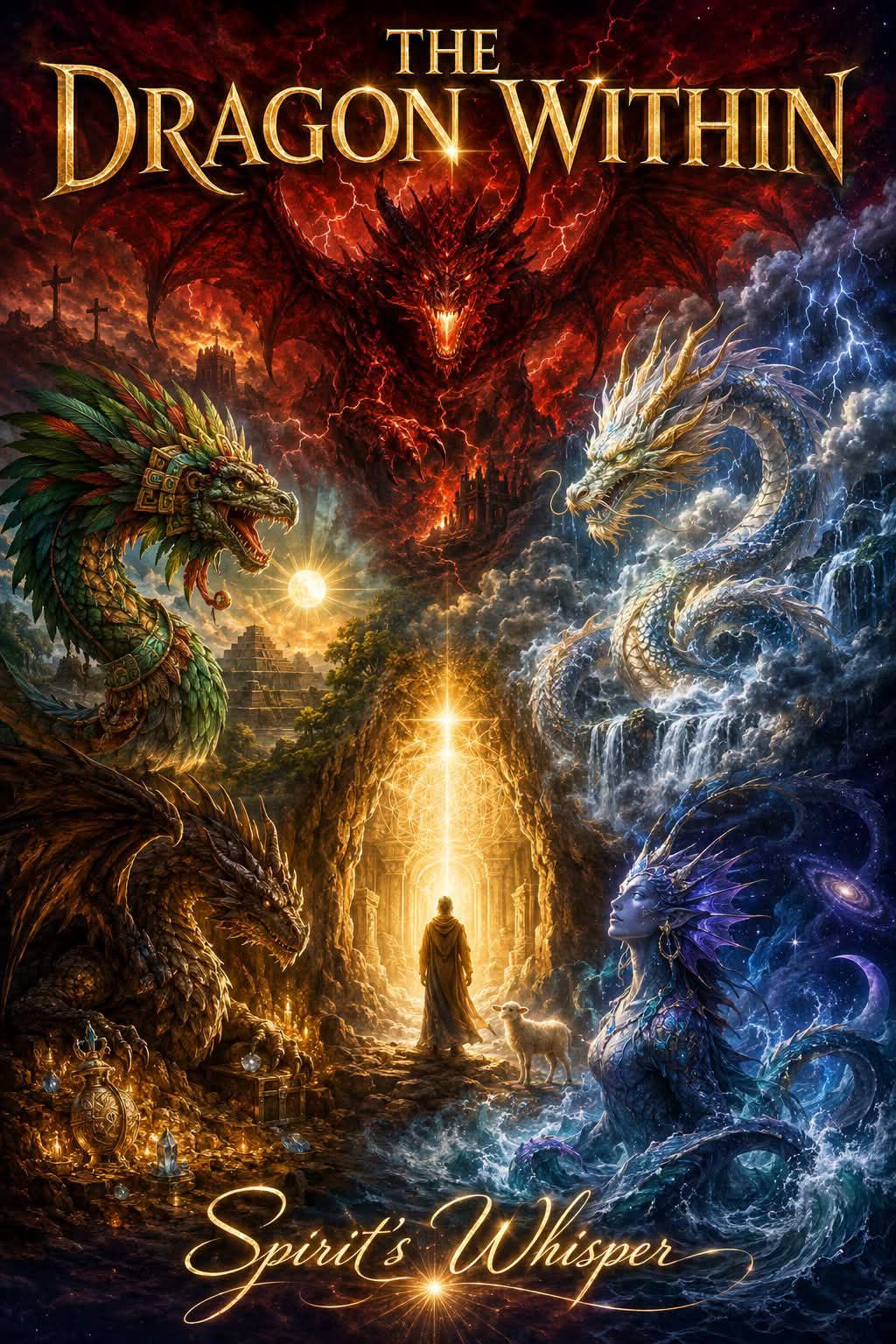
When most people hear the word dragon, they immediately imagine evil.
They picture a monster.
A deceiver.
A creature breathing destruction.
An enemy that must be conquered and slain.
And within certain passages of Scripture, the dragon certainly carries this meaning.
But the dragon is older than any single religious interpretation.
Across ancient cultures, dragons and great serpents have represented chaos and order, destruction and creation, fear and wisdom, death and rebirth, masculine authority and feminine power.
The dragon is not one simple symbol.
The dragon is power.
And power reveals the consciousness through which it moves.
In Scripture, the dragon is often portrayed as an adversarial force.
Isaiah speaks of Leviathan, the fleeing and twisting serpent, the dragon dwelling within the sea.
The Psalms describe God breaking the heads of the sea monsters and crushing Leviathan.
Revelation unveils a great red dragon standing before a woman who is preparing to give birth, waiting to devour her child.
The dragon is later called the ancient serpent, the accuser, and the deceiver of the world.
Esoterically, these images are not merely describing an external creature.
They reveal movements within human consciousness.
The sea represents the deep, unformed waters of the unconscious.
Leviathan represents the ancient chaos hidden beneath the surface of the mind.
The many heads represent the many identities, fears, compulsions, accusations, and illusions through which the false self attempts to rule.
The woman represents the soul—the receptive, intuitive, creative womb within consciousness.
The holy child represents the Christ nature being born within.
And the dragon standing before the woman represents every old pattern that attempts to consume an awakening before it has time to mature.
The dragon always appears near the place of birth.
When a new consciousness begins forming within you, the old identity feels threatened.
When you begin remembering your union with God, fear rises.
When you begin releasing shame, the accusing voice becomes louder.
When you begin stepping beyond religious control, the system may call your freedom rebellion.
When Love begins replacing judgment, the mind conditioned by division begins searching for reasons to remain afraid.
The dragon stands before the womb because the old world knows that when the holy child is born, its throne will begin to fall.
This is the negative expression of dragon energy.
It is power ruled by the false self.
Wisdom separated from Love.
Instinct separated from consciousness.
Strength separated from compassion.
Fire used for domination rather than transformation.
The dragon becomes destructive when power forgets its Divine source.
This is why Revelation calls the dragon the accuser.
The dragon’s greatest weapon is not fire.
It is accusation.
It whispers:
“You are unworthy.”
“You are separate from God.”
“You have failed too many times.”
“You cannot trust what is awakening within you.”
“You must remain afraid.”
“You must remain small.”
“You must remain dependent upon those who claim to stand between you and God.”
Accusation divides consciousness against itself.
It separates the body from the spirit.
The feminine from the masculine.
Humanity from creation.
One religion from another.
The righteous from the sinner.
The chosen from the rejected.
And wherever division is given a throne, the dragon continues to rule.
Yet this is not the only way the ancient world understood the dragon.
In Chinese traditions, the dragon was commonly honored as an auspicious and life-giving being.
Rather than being portrayed merely as an evil monster, the dragon was associated with water, rain, fertility, protection, vitality, happiness, cosmic harmony, and imperial authority.
The dragon moved between heaven, earth, clouds, rivers, and seas.
It represented a power capable of crossing boundaries.
It could descend into the deepest waters and rise into the highest heavens.
Esoterically, this dragon represents the awakened life-force moving freely between the earthly and the Divine.
It is spirit entering matter.
Heaven touching earth.
The invisible becoming visible.
The dragon becomes the flowing current of sacred energy moving through creation.
Its connection with rain is especially meaningful.
Rain descends from heaven and awakens the sleeping seed within the earth.
The dragon, therefore, can symbolize the power that brings hidden potential to life.
It does not destroy the earth.
It fertilizes it.
It does not oppose creation.
It participates in creation.
In this expression, the dragon is not the enemy of awakening.
The dragon is the energy of awakening.
Ancient Mesopotamia also gives us the image of Tiamat, the primordial salt waters and mother of the gods.
Later artistic and mythological interpretations often portray Tiamat as a dragon or enormous sea monster.
But before being reduced to a monster, Tiamat was the ancient deep.
The waters before ordered creation.
The womb of possibility.
The mysterious chaos from which new worlds could emerge.
In the Babylonian creation story, Tiamat is defeated and her body is divided to form the ordered cosmos.
Esoterically, this can be read as more than a story about a hero defeating a monster.
It may preserve the memory of an older feminine creative power being conquered, divided, and reorganized beneath a new masculine religious and political order.
The primordial mother becomes the enemy.
The ancient waters become chaos.
The feminine power of creation becomes something that must be subdued before civilization can begin.
This pattern appears repeatedly throughout religious history.
What cannot be controlled is called dangerous.
What cannot be explained is called deception.
What refuses to bow to established authority is called rebellion.
The intuitive becomes suspicious.
The body becomes sinful.
The earth becomes inferior.
The woman becomes a gateway of temptation.
The serpent of wisdom becomes only a deceiver.
The dragon goddess becomes a monster that must be slain.
But perhaps not every dragon was meant to be killed.
Perhaps some dragons were demonized because they guarded a form of wisdom that emerging systems of power could not control.
In Mesoamerican traditions, the feathered serpent represented another union of apparent opposites.
The serpent moves upon the earth.
The bird moves through the heavens.
Joined together, the feathered serpent becomes a bridge between below and above.
Earth and sky.
Body and spirit.
Instinct and awareness.
Matter and consciousness.
The serpent does not need to reject the earth in order to ascend.
It receives feathers.
The earthly is not abandoned.
It is transformed.
This is a profound esoteric picture of awakening.
True spirituality does not require us to escape the body.
It awakens the Divine within the body.
It does not despise matter.
It reveals spirit moving through matter.
It does not separate heaven from earth.
It discovers that heaven and earth meet within consciousness.
This is also why the dragon can be understood as an expression of the Divine Feminine.
The dragon is not literally identical with every ancient goddess, and not every culture gave it the same meaning.
But symbolically, the dragon often carries qualities associated with the ancient feminine mysteries:
The womb.
The earth.
The waters.
Intuition.
Instinct.
Fertility.
Creation.
Destruction.
Protection.
Death.
Rebirth.
The power to descend into darkness and return carrying wisdom.
The positive dragon is the untamed life-force of the soul.
She is the ancient fire that existed before institutions attempted to define God.
She is the wisdom of the body.
The intelligence of the earth.
The waters beneath creation.
The fire beneath the mountain.
The fierce mother protecting what is being born.
She is not evil because she cannot be controlled.
She is not demonic because she refuses to become passive.
She is not darkness because she descends into the cave.
The cave itself is a feminine symbol.
It is the womb of the earth.
It is the inner chamber.
The hidden place.
The darkness in which transformation occurs before it can be seen.
A seed is buried in darkness.
A child is formed in darkness.
The caterpillar is transformed within darkness.
The soul often discovers its deepest truth after entering the places it was once afraid to face.
Darkness is not always evil.
Sometimes darkness is gestation.
Sometimes it is rest.
Sometimes it is mystery.
Sometimes it is the sacred interior where a new identity is being formed.
This is why dragons are so often portrayed guarding caves and treasure.
Esoterically, the dragon guards the treasure hidden within the depths of the soul.
That treasure is your forgotten identity.
Your buried wisdom.
Your spiritual authority.
Your creative fire.
Your capacity to feel.
Your ability to establish boundaries.
Your connection with the earth, the body, intuition, and the Divine Presence within you.
The dragon may appear terrifying because the treasure cannot be reclaimed without confronting everything that has kept it buried.
Fear guards the treasure.
Shame guards the treasure.
Trauma guards the treasure.
Religious conditioning guards the treasure.
The false identity guards the treasure.
The dragon asks:
“Are you prepared to see what you have hidden?”
“Are you prepared to feel what you have avoided?”
“Are you prepared to stop giving your authority away?”
“Are you prepared to become responsible for the fire within you?”
The dragon is therefore both guardian and test.
It prevents the unprepared ego from possessing sacred power.
Power entered without humility becomes domination.
Knowledge entered without Love becomes manipulation.
Spiritual authority entered without self-awareness becomes control.
Fire entered without wisdom becomes destruction.
The dragon guards the treasure until the seeker is prepared to carry power without becoming possessed by it.
This is where the dragon and the Lamb meet.
The Lamb represents innocence, surrender, gentleness, compassion, and Love.
The dragon represents power, instinct, fire, boundaries, courage, and transformation.
Religion often tells us that one must destroy the other.
But esoterically, wholeness comes when they are reconciled.
The Lamb without the dragon can become passive, powerless, and easily controlled.
The dragon without the Lamb can become violent, dominating, and consumed by its own fire.
But when the dragon bows to Love, power becomes protection.
When the Lamb receives the dragon’s fire, gentleness becomes courageous.
The dragon gives the Lamb boundaries.
The Lamb gives the dragon compassion.
The dragon gives the Lamb a voice.
The Lamb teaches the dragon not to devour.
The dragon teaches the Lamb that surrender is not the same as submission to abuse.
The Lamb teaches the dragon that strength does not require domination.
Together they reveal integrated consciousness.
Fire and water.
Heaven and earth.
Masculine and feminine.
Strength and tenderness.
Power and surrender.
The dragon does not have to be destroyed.
Its distorted rulership must be transformed.
The energy that once became rage can become courage.
The energy that became control can become protection.
The energy that became lust can become creative vitality.
The energy that became accusation can become discernment.
The energy that became rebellion can become liberation.
The energy that became destruction can become the holy fire that burns away what is false.
The fire was never the enemy.
The consciousness directing the fire determined what it became.
This is why the same dragon symbol can appear both terrifying and beautiful across human traditions.
The dragon reflects our relationship with power.
When power is unconscious, it devours.
When power is controlled by fear, it dominates.
When power is denied, it operates from the shadows.
When power is projected, we see monsters everywhere outside ourselves.
But when power becomes conscious and is reunited with Love, it protects life, brings rain to barren ground, guards what is sacred, and gives the soul wings.
The dragon within is sometimes the wounded protector of the inner child.
It learned to breathe fire because tenderness once felt unsafe.
It learned to control because vulnerability once brought pain.
It learned to hoard because it believed there would never be enough.
It learned to accuse because shame had been placed upon it.
It learned to frighten others because it was terrified of being powerless again.
Beneath its scales may be a frightened part of the soul waiting to be acknowledged.
The Christ within does not enter the cave merely to kill that wounded part.
Christ enters the cave carrying Light.
Not to shame the dragon.
Not to fear it.
Not to worship it.
But to transform it.
The accusing dragon is cast down when shame loses its throne.
The serpent is restored when wisdom reunites with Love.
The beast is transformed when instinct becomes conscious.
The goddess rises when feminine power is no longer treated as evil.
The treasure is released when fear no longer guards the inner temple.
Perhaps the dragon of Revelation represents the ancient consciousness of separation rising against the birth of Love.
And perhaps the benevolent dragon of other traditions represents the same primordial power after it has been restored to harmony.
One dragon devours the child.
The other guards the child.
One withholds the waters.
The other brings the rain.
One uses fire to destroy.
The other uses fire to purify.
One hoards the treasure.
The other protects it until humanity is ready to receive it.
The difference is not merely the creature.
The difference is consciousness.
What rules the dragon?
Fear or Love?
Accusation or wisdom?
Domination or protection?
Separation or union?
The dragon is the sacred power within creation.
Unconscious, it becomes the beast.
Awakened, it becomes the guardian.
Separated from Love, it becomes destruction.
Reunited with Love, it becomes transformation.
The spiritual journey is not always about slaying the dragon.
Sometimes it is about entering the cave, listening to its wounds, reclaiming its treasure, and teaching its fire to serve Love.
The dragon within you may not be waiting to die.
It may be waiting to remember what it was created to protect.
Enter the cave without hatred, and stand before the fire without fear.
Ask the dragon what sacred treasure has been hidden beneath its wings.
Let the Lamb awaken compassion, and let the dragon awaken courage.
Reclaim the ancient power that shame taught you to fear.
When your fire remembers Love, the monster becomes the guardian.


You must be logged in to post a comment.