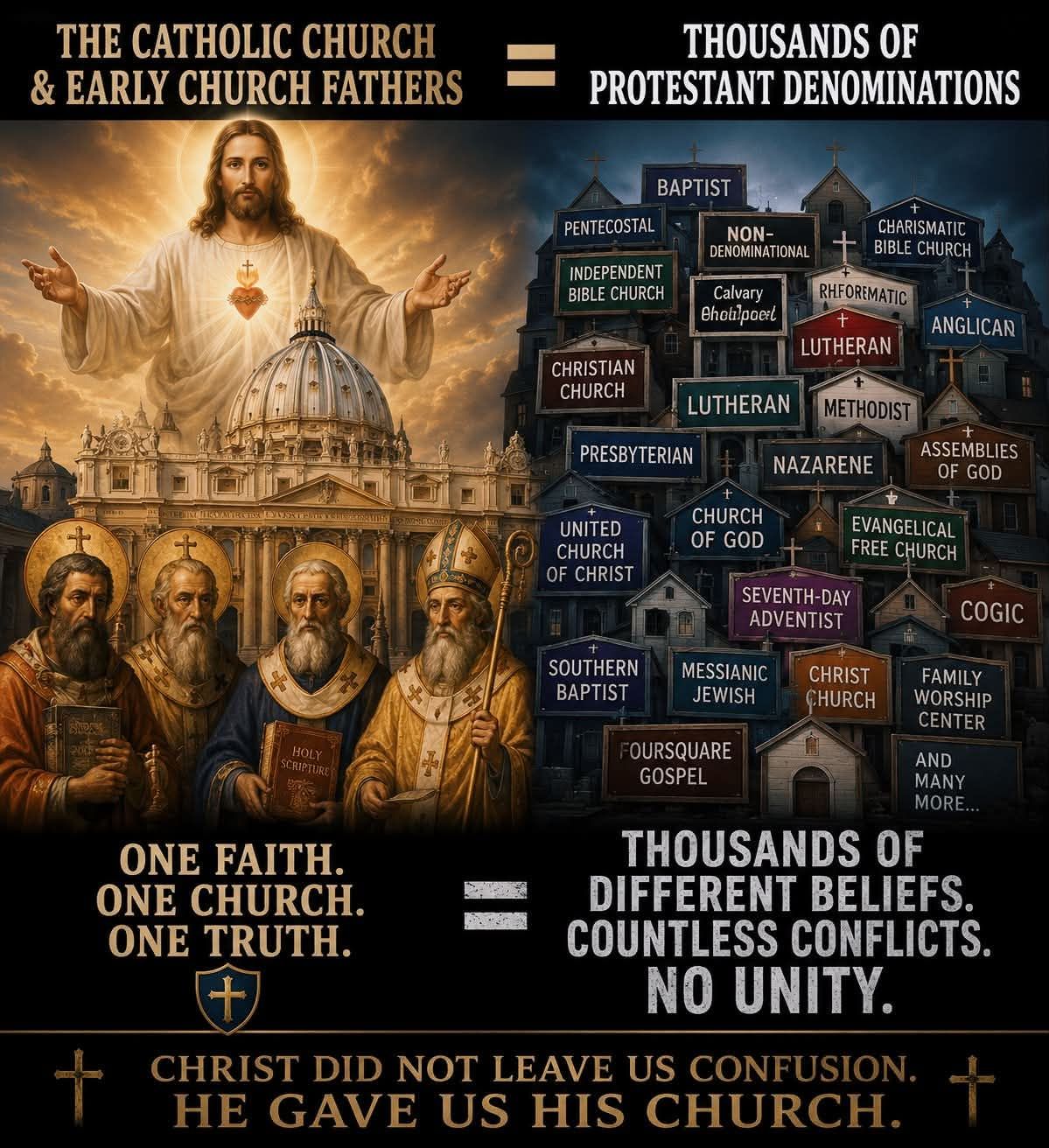
Many Christians say, “I follow the Bible alone.” But no one follows the Bible without interpreting it. The real question has never been whether we interpret Scripture—it is who has the authority to interpret it correctly.
If you dismiss the witness of the early Church Fathers—many of whom were taught by the apostles or by their immediate disciples—you are left with your own interpretation. But why should anyone accept your interpretation over theirs?
The words of Scripture are not the problem. The disagreement lies in their interpretation. Once every individual becomes his own final authority, every interpretation can claim to be biblical. That is exactly what history has shown.
This is why Protestantism has fractured into thousands of denominations, each claiming to follow the same Bible while disagreeing on essential doctrines such as baptism, the Eucharist, salvation, eternal security, predestination, church government, spiritual gifts, the end times, divorce and remarriage, women in ministry, the Sabbath, and many other issues.
History also demonstrates where private interpretation can lead. Groups such as the Branch Davidians, the Peoples Temple, Heaven’s Gate, and countless other sects all claimed to base their teachings on Scripture. The problem was never the Bible—it was whose interpretation people trusted.
Christ did not leave us a book alone. He established a Church before a single word of the New Testament was written. That Church preserved the apostolic faith, discerned the canon of Scripture, and faithfully handed down the teaching it had received from the apostles.
This is why Catholics look not only to Scripture but also to the continuous witness of the early Church Fathers. They provide the historical evidence of how the apostles’ teachings were understood by the first generations of Christians. If a doctrine cannot be found among those closest to the apostles, extraordinary evidence is required to prove it is truly apostolic.
That is why modern innovations deserve careful scrutiny.
For example, dispensationalism—with its teaching that God has two distinct covenant peoples and that the modern State of Israel occupies a separate prophetic role apart from Christ and His Church—was unknown throughout historic Christianity for nearly 1,800 years. It was systematized in the nineteenth century by John Nelson Darby and later popularized through the Scofield Reference Bible.
The question is simple:
If this interpretation was truly taught by the apostles, where was it for the first 1,800 years of Christianity?
Show us the early Church Father, the ecumenical council, or the major Christian theologian before the nineteenth century who taught it.
The burden of proof rests on anyone introducing a doctrine that was unknown to the Church founded by Christ and absent from the faith handed down from the apostles.


You must be logged in to post a comment.