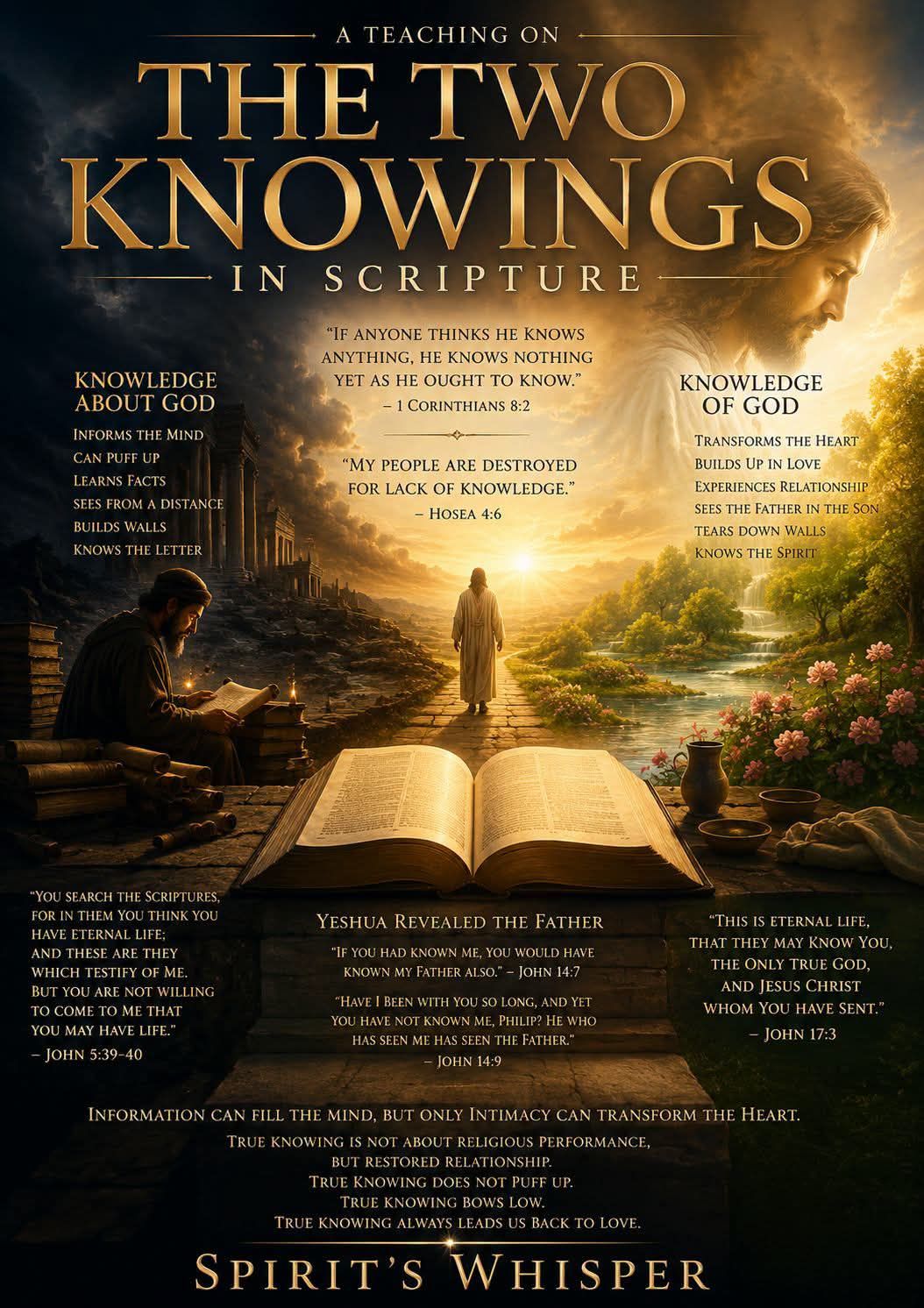
There are two kinds of knowing spoken of in Scripture.
One knowing fills the mind with information.
The other knowing awakens the heart into union.
And sometimes, the more we think we know, the farther we can drift from the kind of knowing God actually desires.
Paul says:
“If anyone thinks he knows anything, he knows nothing yet as he ought to know.”
— 1 Corinthians 8:2
That is a powerful sentence.
Paul is not attacking learning.
He is not saying knowledge is evil.
He is not telling people to stay ignorant.
He is revealing that there is a kind of knowledge that can make a person proud, religious, argumentative, and blind.
A person can know verses and still not know love.
A person can know doctrine and still not know the Father.
A person can know Greek words, Hebrew words, theology, traditions, arguments, and church history — and still not know as they ought to know.
Because knowledge without love becomes weight.
Knowledge without humility becomes pride.
Knowledge without union becomes separation.
Paul says just before this:
“Knowledge puffs up, but love builds up.”
— 1 Corinthians 8:1
So there is a knowledge that inflates the self.
And there is a knowledge that forms Christ within.
One makes you feel above people.
The other teaches you how to wash feet.
One wants to win arguments.
The other wants to reveal the Father.
This is why Hosea says:
“My people are destroyed for lack of knowledge.”
— Hosea 4:6
But the word for “knowledge” there is not merely information.
In Hebrew, the word is “da‘ath,” connected to intimate, relational knowing. It is not just knowing facts about God. It is knowing God in covenant, in experience, in relationship, in awareness, in union.
It is the kind of knowing that changes how you live.
It is the kind of knowing that aligns the heart.
It is the kind of knowing that causes a person to recognize the voice of the Shepherd, not just quote the Shepherd.
So when Scripture says people perish for lack of knowledge, it is not only saying they lacked Bible trivia.
It is saying they lost the awareness of God.
They lost intimacy.
They lost the living connection.
They had religion, but not relationship.
They had rituals, but not reverence.
They had sacrifice, but not mercy.
They had the temple, but missed the Presence.
And this is exactly what Yeshua came revealing.
Yeshua did not come merely to give people more information about God.
He came to reveal the Father.
He said:
“If you had known Me, you would have known My Father also.”
— John 14:7
And when Philip said, “Show us the Father,” Yeshua answered:
“Have I been with you so long, and yet you have not known Me, Philip? He who has seen Me has seen the Father.”
— John 14:9
That word “known” is not distant.
It is not casual.
It is not religious observation from the outside.
It speaks of recognition.
Intimate awareness.
To know Yeshua was to recognize the Father being expressed through Him.
Not a violent Father.
Not a distant Father.
Not an angry Father waiting to destroy His children.
But a Father revealed through compassion, mercy, healing, forgiveness, patience, correction, truth, and love.
Yeshua said:
“This is eternal life, that they may know You, the only true God, and Jesus Christ whom You have sent.”
— John 17:3
Notice what eternal life is.
It is not defined first as going somewhere after you die.
Yeshua says eternal life is knowing the Father.
That means eternal life is relational.
It is awakened consciousness.
It is union with the Source.
It is the heart returning to the One it came from.
So there is a knowing that studies God from a distance.
And there is a knowing that becomes aware of God within.
There is a knowing that says, “I have the right answers.”
And there is a knowing that says, “Father, make me one with You.”
There is a knowing that builds walls.
And there is a knowing that restores sons.
This is why Yeshua could say to religious people, people who searched the Scriptures:
“You search the Scriptures, for in them you think you have eternal life; and these are they which testify of Me. But you are not willing to come to Me that you may have life.”
— John 5:39–40
They knew the scrolls.
But they did not recognize the Life standing in front of them.
They knew the letter.
But missed the Spirit.
They knew the law.
But missed love.
And maybe that is the warning for all of us.
Because we can know about prayer and still not pray.
We can know about surrender and still hold control.
We can know about love and still treat people harshly.
We can know about the Father and still live like orphans.
But the knowing Yeshua came to reveal was deeper.
He came to awaken remembrance.
He came to show us that the Father was not far away.
He came to bring the heart back into alignment.
He came to reveal that knowing God is not about religious performance, but restored relationship.
The mind may gather information.
But the heart must return.
And when the heart returns, knowledge becomes wisdom.
Doctrine becomes love.
Scripture becomes living bread.
Prayer becomes communion.
And God is no longer an idea we defend.
He becomes the Father we know.
So maybe the question is not just, “What do I know?”
Maybe the better question is:
Who am I becoming through what I know?
Is my knowledge making me more loving?
More humble?
More merciful?
More surrendered?
More like the Father?
Because true knowing does not puff up.
True knowing bows low.
True knowing builds up.
True knowing restores the image.
And true knowing always leads us back to love.
Do not only seek to know about Me.
Come and know Me.
Let your heart return to the Father.
And what is true will become alive in you.


You must be logged in to post a comment.