Alright. Everybody sit down. Close the group chats. Put the phone face-down.
Because I’m about to teach you something your pastor, your priest, and your Sunday school teacher spent twenty years hoping you’d never think to ask.
We’re going to talk about buildings.
Not literally. Stay with me.
Every structure that has ever stood was built on something. A foundation. And the one rule every builder who has ever lived has understood — even the ones who couldn’t read — is this:
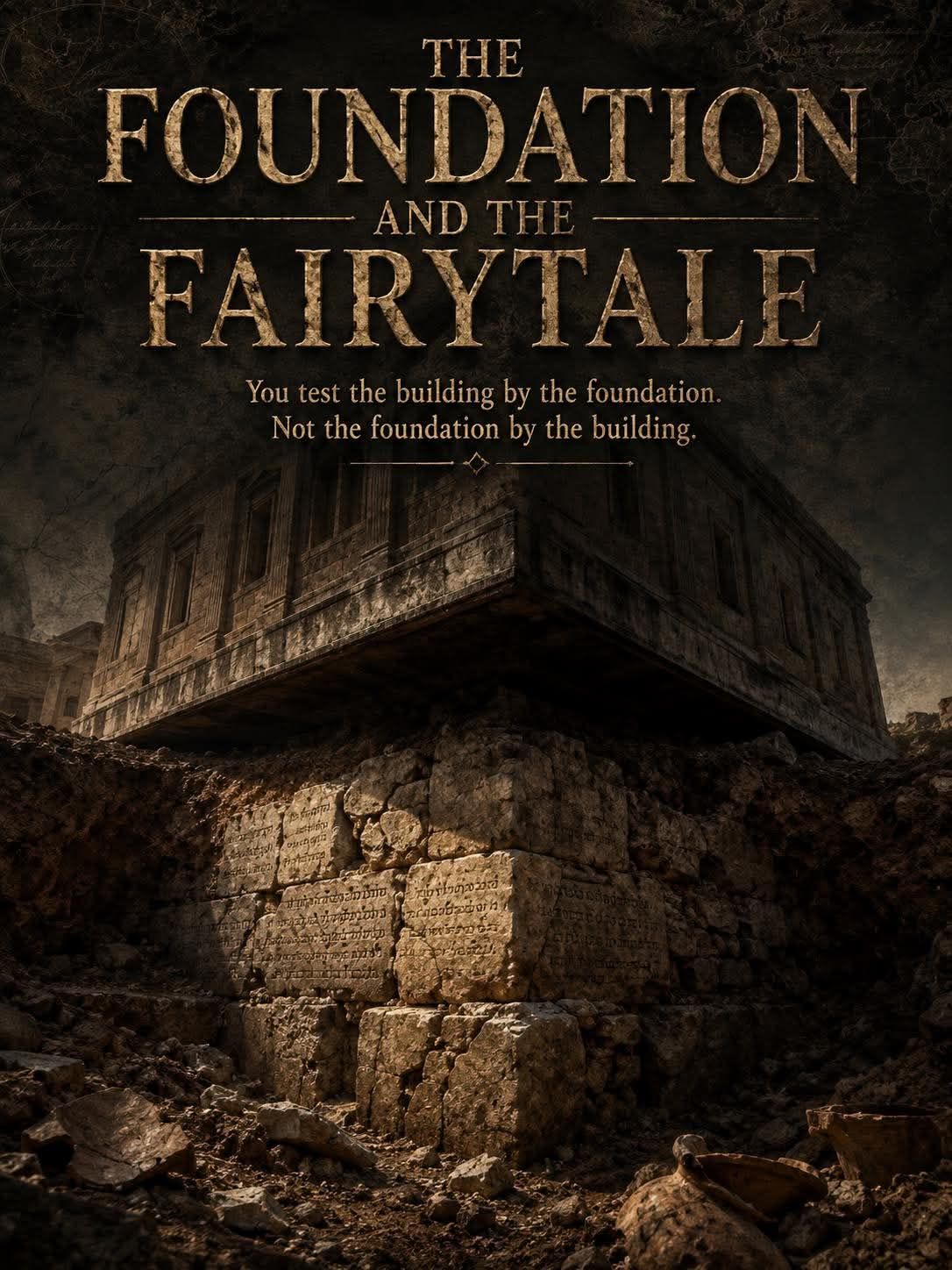
You test the building by the foundation. Not the foundation by the building.
Write that down.
Because that one sentence is about to change how you read everything.
Now. We have two documents before us today.
I’m not going to name them. We’re going to call the first one The Foundation. It is ancient. It is consistent. It establishes the character of Yahuah — His instructions, His covenant, His standards, His authority, His promises. It was given first. It defines truth. It defines righteousness. It defines sin. It defines obedience. It defines who Yahuah is.
And we’re going to call the second one The Fairytale. It came later. It claims to stand on The Foundation. It claims to complete it. It claims to be its fulfillment.
That is the claim.
Now here is the assignment:
We test it.
Not emotionally. Not traditionally. Not because grandma cried when she read it. We test it the only way any honest builder tests anything.
Against the foundation it claims to stand on.
The Foundation tells us exactly how to do this. It doesn’t leave us guessing.
“To the Torah and to the witness! If they do not speak according to this word, it is because there is no light in them.”
— Isaiah 8:20
That is not my opinion. That is not a theological position. That is the Foundation’s own instructions for how to handle every claim that comes after it.
If it doesn’t agree with what was already established, there is no light in it.
That’s the test. That’s always been the test.
The Foundation also says this:
“Remember the Torah of Mosheh My servant, which I commanded him in Horeb for all Yisra’el, laws and right-rulings.”
— Malachi 4:4
You know what’s significant about that verse? It’s the last prophetic instruction before centuries of silence. The final word before the long pause.
And that final word was not: “Stay tuned for a new standard.”
It was: “Remember what you were already given.”
The ancient writings preserved outside the mainstream canon echo this without apology.
“Do not add to the words which I speak unto you, neither take away from them.”
— Sirach 18:6
Preservation. Not alteration. Not expansion. Not revision.
Even the community at Qumran, the men who copied and guarded the Dead Sea Scrolls, understood this. Their governing document records it plainly:
“They shall separate from the habitation of unjust men and go into the wilderness to prepare the way.”
— Community Rule 8
They didn’t prepare the way by building something new. They prepared the way by returning to what was already revealed. By covenant faithfulness. By measuring everything against the standard that already existed.
So before we go any further, understand what we are standing on.
The Foundation came first. The Foundation defines truth. Therefore, anything built on top of it must agree with it completely.
Not mostly. Not spiritually. Not symbolically.
Completely.
If it doesn’t, the problem is not the Foundation.
Now. Class. You following me? Good.
Because now it gets uncomfortable.
Every deception in history started the same way.
Not with an obvious lie. Obvious lies get rejected. Obvious lies are easy.
The dangerous ones start with something close enough to the truth that most people never stop to question it.
The strongest counterfeit is never the one that looks different.
It’s the one that looks almost identical.
That’s why we inspect for cracks.
A crack doesn’t mean the whole structure collapses. But it does mean something beneath the surface demands investigation.
The Foundation established certain truths. Non-negotiable. Foundational.
Yahuah does not change. Truth does not change. Righteousness does not change. The standard does not change. The covenant does not change.
Now. What happens when a later document contains teachings that seem to move in directions the Foundation never established? What happens when some statements require lengthy explanations, commentaries, theological gymnastics, and seminary degrees just to make them appear consistent with earlier revelation? What happens when accounts of the same event tell the story differently in ways that cannot both be right? What happens when some passages appear to contradict the very character of Yahuah that the Foundation spent centuries establishing?
What does a critical thinker do with that?
Most people, and this is just science, defend it.
Psychologists call it confirmation bias. When we encounter information that threatens something we’ve deeply believed, something we were raised inside of, something our family depends on, something our identity is wrapped around, our first instinct is almost never investigation.
It’s defense.
We hunt for evidence that protects our conclusions. We build walls around our assumptions. We find teachers who tell us what we need to hear. We accept explanations without examining them. And so entire generations become guardians of a structure they have never once fully inspected.
The Foundation says something very specific about this:
“The prophet who presumes to speak a word in My Name which I have not commanded him to speak…”
— Deuteronomy 18:20
Yahuah repeatedly, not once, not twice, repeatedly commands His people to test every claim of authority.
And then this:
“How do you say, ‘We are wise, and the Torah of Yahuah is with us’? But look, the lying pen of the scribes has made it into a lie.”
— Jeremiah 8:8
Sit with that one for a second.
Jeremiah is not talking about pagans. He is talking about people who called themselves wise. People who believed they carried truth. And he is telling them plainly, the scribes corrupted it.
Religious writings and religious teachers can become corrupted. The Foundation says so.
The ancient texts preserved outside the mainstream canon warned this too:
“For many are deceived by their own opinion; an evil suspicion hath overthrown their judgment.”
— Sirach 3:24
And the community that produced the Dead Sea Scrolls spent their entire existence operating from a framework built on a single premise, not everything claiming to be light is light. Their documents describe two paths, two spirits, two directions. One walks in truth. One walks in deception. And the job of every serious seeker is to know the difference.
So here is where I need you to be honest with yourself.
If you have been handed a structure and told never to question it, if you have been taught that examination is rebellion, if you have been warned that investigating the foundation is dangerous,
Ask yourself who benefits from your silence.
Because the Foundation never told you not to question. It told you to test everything. It told you to examine. It told you to prove.
The cracks are not the problem.
Refusing to look at them is.
Because once you see a crack clearly, truly see it, you cannot pretend it isn’t there.
And some cracks run all the way to the bottom.
For a long time, I thought the problem was me.
I assumed I needed better explanations. More commentaries. More teachers. More theology. More creative ways to force pieces together that weren’t fitting.
So I went back to the Foundation.
And something shifted.
The more closely I examined it, the more difficult it became to ignore what I was seeing. The Foundation was clear. The structure built on top of it was not. The Foundation was consistent. The structure required explanations. The Foundation spoke with one voice. The structure sounded like many voices competing for the same authority.
And I kept returning to three statements from the Foundation that I could not explain away:
“For I am Yahuah, I shall not change.”
— Malachi 3:6
“The sum of Your word is truth, and all Your righteous right-rulings are forever.”
— Psalms 119:160
“You shall not add to the word which I command you, nor take away from it.”
— Deuteronomy 4:2
Not suggestions. Commands. Backed by the character of a Being who declared He does not change.
If He does not change, His standard cannot contradict itself. And if something later contradicts that standard, only one of them can be right.
The ancient writings outside the mainstream canon reinforce the same conclusion:
“Seek not things that are too hard for thee… but what is commanded thee, think thereupon with reverence.”
— Sirach 3:21–22
Stay anchored to what was revealed. Don’t chase complexity as a substitute for obedience.
The Damascus Document, one of the key writings among the Dead Sea Scrolls, says it plainly:
“Hold fast to the covenant and walk according to all that was revealed.”
Not according to what came later. Not according to the new development. According to what was revealed.
So here is the verdict. And I’m going to say it without flinching.
Truth must be judged by the Foundation. Not the other way around.
If something agrees with the Foundation, it stands. If it contradicts the Foundation, it falls. No matter how old it is. No matter how popular it is. No matter how many people believe it. No matter how many traditions depend on it. No matter what it costs you to admit it.
Truth does not need protection. Truth only needs examination.
And that examination begins where it always should have begun.
With the Foundation.
THE MISSING WITNESS
Alright. Class isn’t dismissed yet.
Sit back down.
Because now I want to ask you a different kind of question. Not whether something was added to the story.
But whether something was removed.
Because here’s what kept me up at night after I ran the tests and checked the cracks and came to the verdict:
When I set the Foundation beside the structure built on top of it, something felt wrong. Not just wrong in the way a contradiction feels wrong. Wrong in the way a puzzle feels wrong when you realize pieces are missing.
The outline is there. The image is partially visible. But somewhere between the beginning and the ending, something disappeared.
A thread that should connect the pieces. A testimony that should be standing in plain sight. A witness that made everything make sense before the trail went cold.
Now. I want you to think about what you know about history, not religious history, just history.
Empires have burned libraries. Kings have silenced witnesses. Religious authorities have voted on which documents get preserved and which ones disappear.
That is not speculation. That is not conspiracy theory.
That is documented history.
The library at Alexandria. The Council of Nicaea. The Inquisition. Private archives that have never been made public. Fragments that sat in the possession of a single institution for decades before other scholars were allowed to see them.
History is written by those who preserve it. But it is shaped by those who bury it.
So what if the real question was never whether the Fairytale is completely true or completely false?
What if the deeper mystery is that fragments of genuine truth are scattered inside it, enough to be recognizable, enough to be convincing, enough to make a serious seeker stop and wonder if there’s something real beneath the fiction?
Because counterfeits that contain no truth are easy to reject.
Counterfeits that contain some truth are almost impossible to let go of.
What if something was taken?
Not a verse. Not a chapter.
A whole record.
A scroll. A testimony. A book that once sat between the Foundation and the structure, connecting the two, making sense of things that currently make no sense, and then simply…
vanished.
History has precedent for exactly this. Repeatedly.
And if that record still exists somewhere, in a forgotten archive, in a private collection, beneath the dust of an excavation site not yet fully reported, among fragments not yet translated and released to the public,
Then the greatest religious discovery in human history may not be finding something new.
It may be recovering what was buried.
I’m not telling you what to conclude.
I’m telling you to keep asking.
Because the most dangerous thing in any investigation is not the question you ask.
It’s the one you were trained never to think of.
And I think you just thought of it.
P.S.
You were taught that the Fairytale completes the Foundation. But nobody ever stopped to ask why the Foundation never mentioned it was coming. Not once. Not a single verse in the entire Foundation that says, “After centuries of silence, a new collection of writings will arrive, written by different men in a different language, and that collection will become equal in authority to everything I have already given you.” Not once. A Father who tells His children everything they need. A Lawgiver who commands nothing be added. A covenant sealed and declared complete. And then silence. And then strangers arrive with new documents. And somehow the burden of proof fell on the Foundation. Think about that. The oldest. The original. The established. The tested. Was made to answer to the new. That is not how foundations work. That is not how truth works. That is not how Yahuah works. That is how replacements work.


You must be logged in to post a comment.