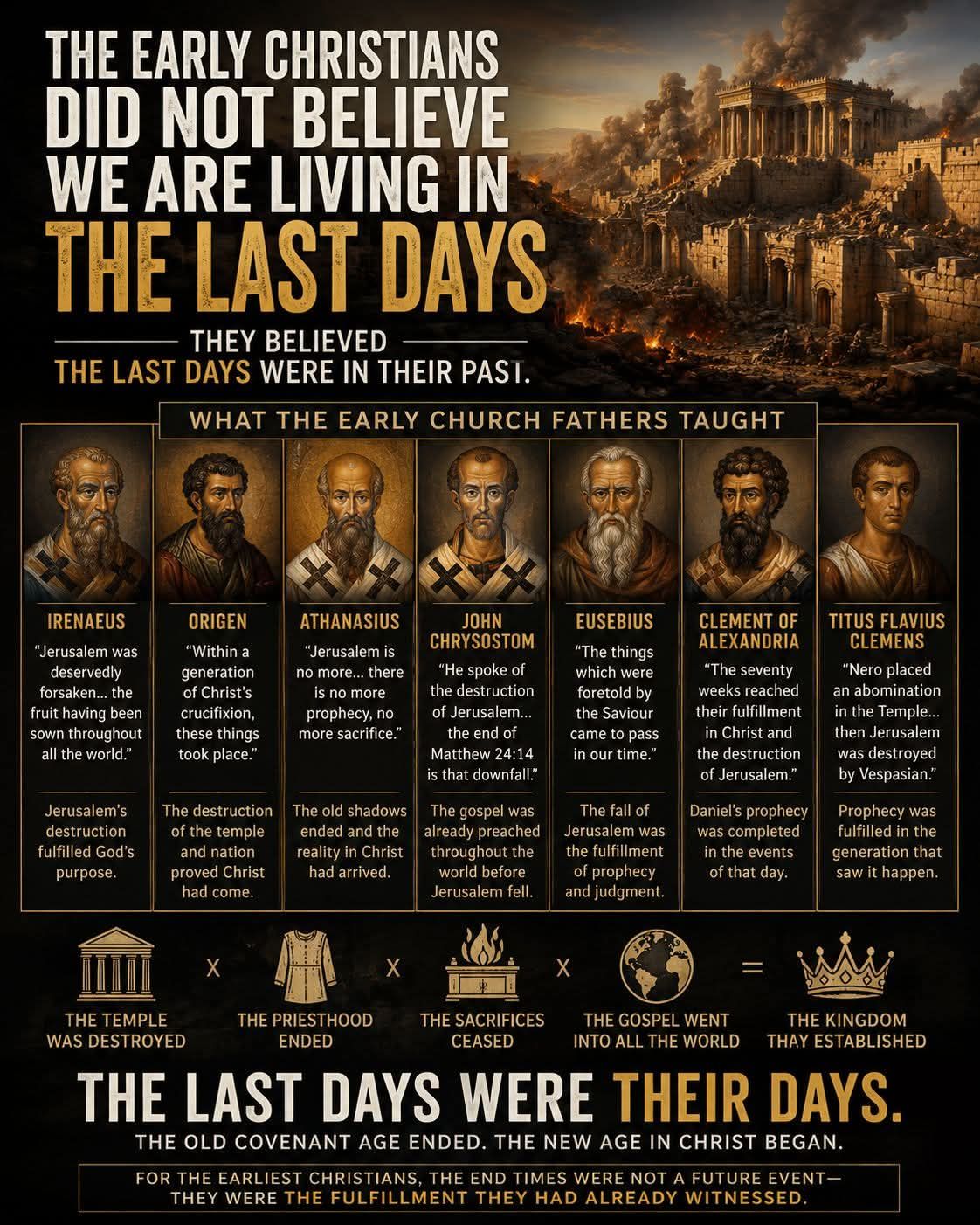
The Early Christians Did Not Believe We Were Living in the Last Days.
One of the most common assumptions in modern Christianity is that we are living in the “last days” and waiting for the fulfillment of end-times prophecy.
Yet when we examine both the New Testament and the writings of the earliest Christians, a very different picture emerges.
The first Christians believed they themselves were living in the last days.
The New Testament repeatedly speaks of the end as near, at hand, approaching, and about to occur.
Jesus told His disciples, “This generation shall not pass, till all these things be fulfilled.”
Peter declared that Joel’s prophecy was being fulfilled in his own day.
The writer of Hebrews said God had spoken “in these last days” and that the old covenant was “ready to vanish away.”
John wrote, “Little children, it is the last hour.”
The earliest Christian writers after the apostles continued to understand these prophecies in that same historical context.
Irenaeus explained that Jerusalem was forsaken because its covenant purpose had been fulfilled. The fruit had matured, been gathered, and scattered throughout the world. He taught that the law terminated with John and that Jerusalem’s legislation ended when the new covenant was revealed.
Origen argued that Jerusalem’s destruction occurred within a generation of Christ’s crucifixion and pointed to the destruction of the temple, priesthood, sacrifices, and Jewish national institutions as evidence that the Messiah had already come.
Athanasius declared that Jerusalem no longer stood, prophecy had ceased, sacrifice had ended, and the old shadows had given way to the reality found in Christ. He argued that these historical facts were proof that the promises concerning Christ had already been fulfilled.
Chrysostom repeatedly taught that Matthew 24 referred to the destruction of Jerusalem. He identified the “end” of Matthew 24:14 as the downfall of Jerusalem and insisted that the gospel had already been preached throughout the world before that event occurred.
Eusebius viewed the Roman destruction of Jerusalem as the fulfillment of Christ’s predictions, the culmination of Daniel’s prophecies, and the judgment that came upon the generation that rejected Christ.
Clement of Alexandria connected Daniel’s seventy weeks to Christ and the destruction of Jerusalem, teaching that the prophecy reached its fulfillment in the events surrounding the Jewish War and the fall of the temple.
Again and again, these early Christian writers pointed backward, not forward.
They looked to the destruction of Jerusalem, the end of the temple system, the cessation of sacrifice, and the worldwide spread of the gospel as the fulfillment of what Jesus and the apostles had foretold.
They did not speak as people waiting for the arrival of the last days.
They spoke as people who believed the last days had already arrived and that the old covenant world was passing away before their eyes.
The “last days” were the last days of the Mosaic age.
The “end of the age” was the end of the old covenant order.
The destruction of Jerusalem in AD 70 marked the public and historical conclusion of that transition.
This does not mean the early Christians believed history was ending.
Quite the opposite.
They believed a new age had begun.
The shadows had given way to the substance.
The old covenant had given way to the new.
The kingdom had been established, the gospel had gone into the world, and the age of fulfillment had arrived.
For the earliest Christians, the end times were not ahead of them.
They were behind them.
“we are living in the last days and we can literally see prophecy unfolding before our very eyes”
Is PURE silliness.


You must be logged in to post a comment.