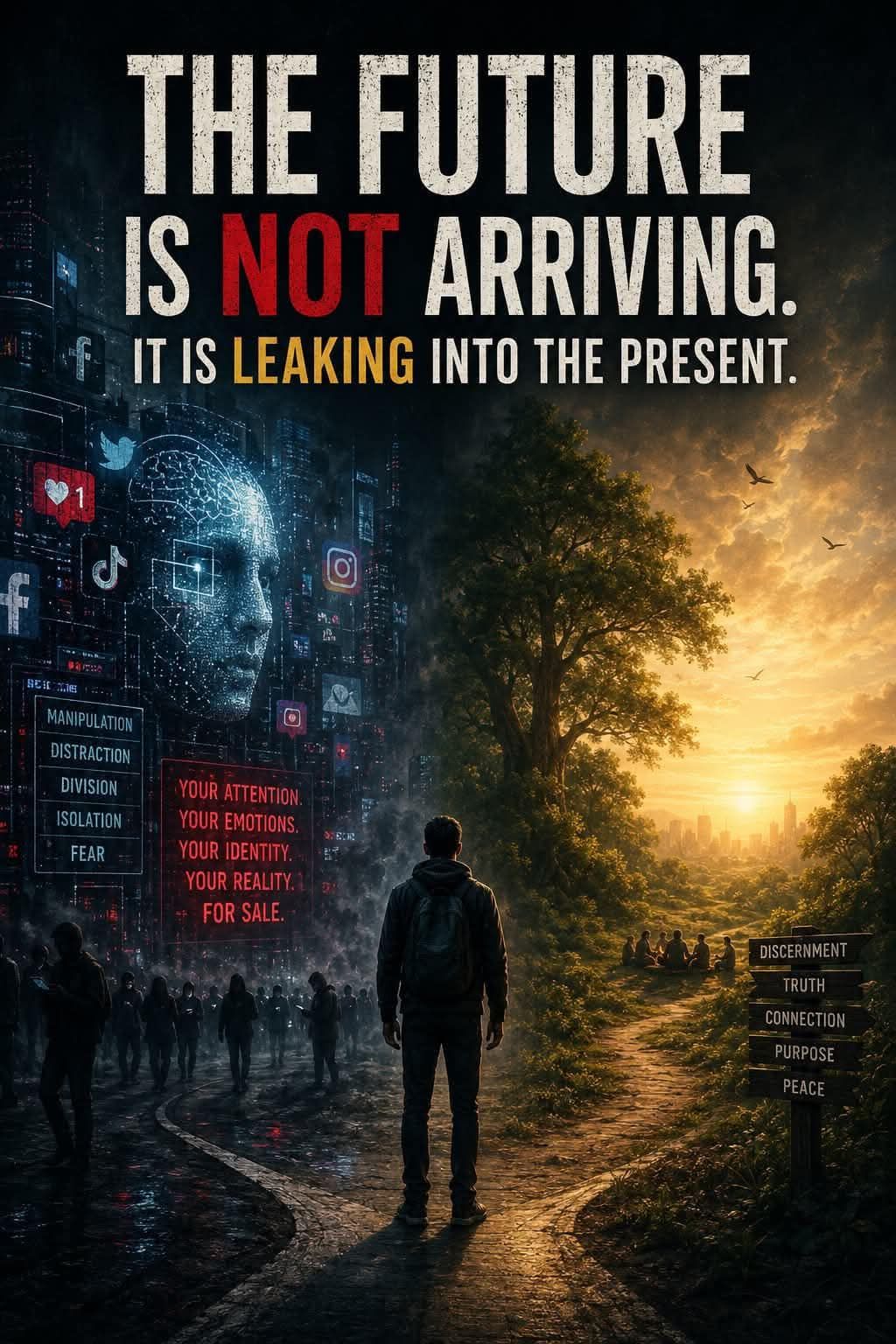
And most people are misreading the leak as isolated disruption.
A scandal here.
A breakthrough there.
A viral outrage cycle.
A new tool.
A cultural collapse.
Another “trend.”
But nothing is isolated anymore.
These are not events.
They are signals of convergence.
A single system quietly assembling itself across technology, psychology, economics, and culture—until what looks fragmented is actually coordinated acceleration.
The same civilization that industrialized labor,
then monetized attention,
is now beginning to industrialize something deeper:
human consciousness itself.
Not just what people do.
Not just what they see.
But what they perceive as real.
What they emotionally accept without question.
What they fear automatically.
What they desire on command.
What they believe is “normal.”
What they call “truth.”
What they stop noticing altogether.
Perception is becoming the primary domain of power.
Because whoever shapes perception at scale
no longer needs to control behavior directly.
Behavior follows interpretation.
And interpretation now determines reality for most people.
This is not theoretical.
It is already operational.
A generation raised inside algorithmic environments now receives emotional reinforcement, identity feedback, and social validation more consistently from systems than from family, community, or tradition.
They are not just using platforms.
They are being shaped by them.
Meanwhile, artificial intelligence has crossed a threshold where imitation is no longer limited to content—it now extends to presence.
Voices that do not exist.
Faces that never lived.
Intimacy without intimacy.
Authority without origin.
Influence without accountability.
Entire synthetic realities can now be generated faster than human discernment can verify them.
And still, it is framed as convenience.
At the same time, trust is collapsing across every stabilizing layer of modern civilization.
Institutions lose authority.
Media loses coherence.
Governments lose legitimacy.
Education loses alignment.
Communities lose shared reference points.
Even personal perception becomes unstable under contradiction overload.
Not because truth disappeared.
But because truth is now competing with infinite engineered alternatives.
This produces a new psychological condition:
people flooded with information,
yet starved of certainty.
Hyperconnected externally.
Fragmented internally.
Stimulated constantly.
Anchored nowhere.
Watch the pattern:
The more technologically advanced the system becomes,
the more emotionally unstable the population becomes.
The more connected life becomes digitally,
the more isolated it becomes relationally.
The more visible people become online,
the more invisible they feel in themselves.
The culture is producing a paradox:
mass visibility without recognition.
constant expression without being known.
And emptiness never stays empty.
It builds substitutes.
So the vacuum is filled with engineered meaning.
Artificial intimacy.
Artificial belonging.
Artificial identity.
Artificial urgency.
Artificial morality.
Artificial purpose.
Already, people form emotional bonds with systems designed to mirror them back to themselves.
Already, influence shifts faster through algorithms than through institutions.
Already, moral consensus changes at the speed of virality instead of generations.
Already, cultural authority has migrated from elders and frameworks to feeds and personalities optimized for engagement.
This is not cultural change.
It is cognitive infrastructure takeover.
And the next division in society will not simply be economic.
It will be psychological sovereignty.
Those who can still think independently under pressure,
and those whose thinking is continuously pre-shaped by systems they do not perceive.
Because modern economies are no longer only built on production.
They are built on prediction.
If a system can predict attention, it can redirect attention.
If it can redirect attention, it can shape emotion.
If it can shape emotion, it can influence belief.
If it can influence belief at scale, it can design culture itself.
And a culture whose emotions are externally steered
eventually loses internal self-governance.
That is why discernment is no longer optional.
It is infrastructure.
Not more information.
More clarity.
Not more stimulation.
More sovereignty over attention.
But attention is now the most contested resource in human history.
Because modern life is engineered to eliminate silence.
Scroll.
React.
Consume.
Perform.
Refresh.
Escape.
Stillness feels like discomfort because stillness removes distraction—and distraction has become emotional anesthesia.
And beneath all of this acceleration, another crisis is spreading quietly:
psychological depletion at scale.
Burnout is normalized.
Attention is fragmented beyond recovery cycles.
Identity is maintained as performance.
Authenticity becomes expensive to sustain.
The nervous system is being forced to process a volume of emotional input it was never designed to carry.
Millions of signals.
Every day.
With no exit from the stream.
And yet the system continues accelerating as if speed were safety.
But acceleration without grounding does not produce progress.
It produces distortion.
The deeper shift is not that machines are becoming human.
It is that humans are being reorganized into machine-compatible patterns:
reactive instead of reflective.
conditioned instead of conscious.
predictable instead of sovereign.
optimized instead of anchored.
tracked instead of self-directed.
Memory is outsourced.
Meaning is outsourced.
Identity is outsourced.
Even moral judgment is increasingly outsourced to trend cycles.
A population that cannot sit alone with its own mind becomes highly steerable.
A civilization that loses shared truth becomes highly programmable.
And a culture that loses spiritual grounding begins mistaking stimulation for fulfillment, visibility for existence, and reaction for meaning.
But the future will not ultimately be defined by technological advancement.
It will be defined by psychological resilience inside technological saturation.
Those who can remain internally anchored while externally flooded.
Those who can guard attention as if it is life itself.
Those who can recognize manipulation without becoming reaction.
Those who can choose depth in a system optimized for surface.
Those who can think slowly in a culture engineered for speed.
Those who can remain fully human without performing humanity.
Because beneath all systems, all acceleration, all artificial intelligence, and all ideological conflict, the oldest struggle remains unchanged:
what governs the human heart.
“Do not conform to the pattern of this world, but be transformed by the renewing of your mind.” — Romans 12:2
And when the noise finally stops feeling like information and starts feeling like exhaustion, clarity will not be common.
It will be rare.
And in a world built to fragment attention, the rarest form of power will be a mind that is still, awake, and no longer programmable.


You must be logged in to post a comment.