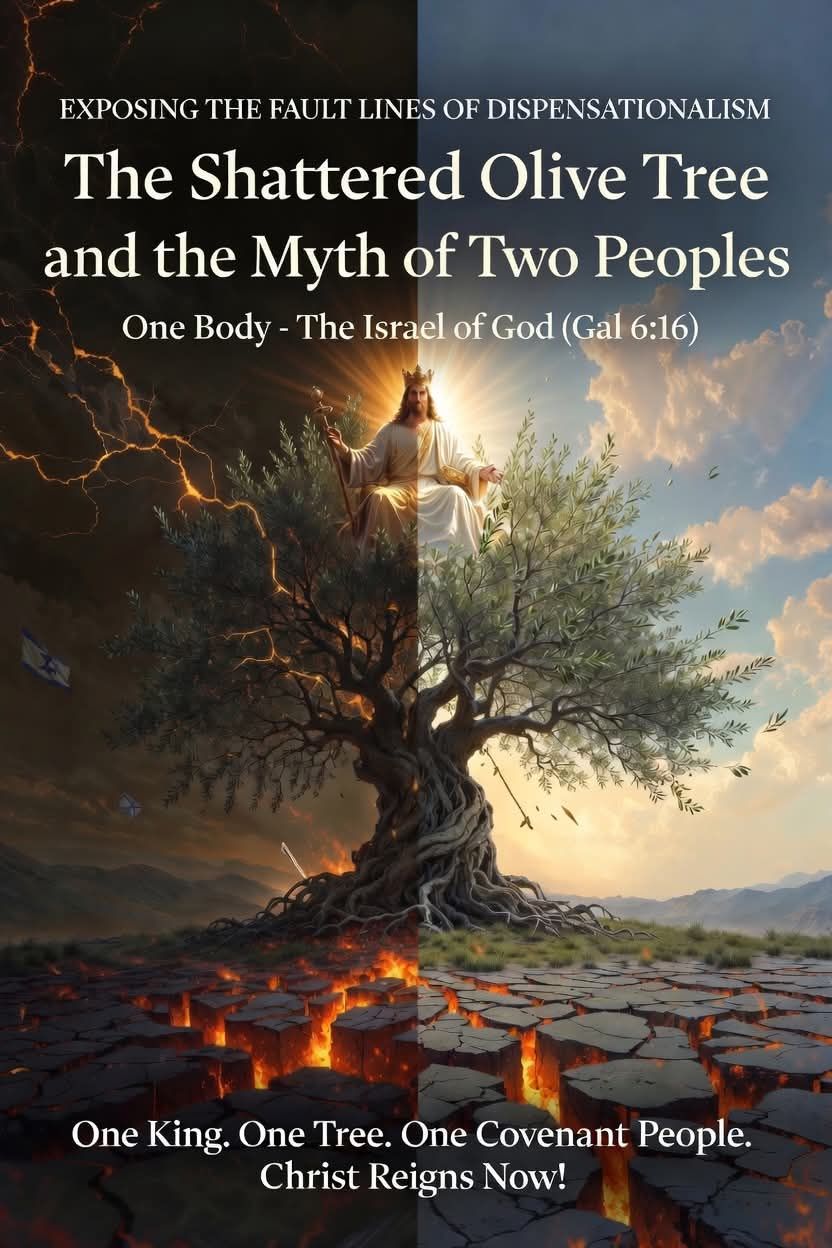
In the radiant light of Christ’s present heavenly reign—far above all principality, and power, and might, and dominion, where God hath put all things under his feet, and gave him to be the head over all things to the church, which is his body (Eph. 1:20–22 KJV)—the dispensational edifice collapses under its own weight. Zionist dreams of a restored ethnic Israel with a separate future destiny fracture against the unbreakable reality of one covenant people, one olive tree, one body. The church is not an afterthought or a parenthesis; she is the Israel of God (Gal. 6:16 KJV), the spiritual seed of Abraham in whom every promise finds its resounding Yes and Amen in the ascended King.
Dispensationalism’s fatal error lies in its stubborn insistence on two Israels: a physical nation still awaiting national salvation and a spiritual church relegated to a secondary role until some future tribulation drama unfolds. This scheme shatters the unity Scripture relentlessly proclaims. As it is written, “Not as though the word of God hath taken none effect. For they are not all Israel, which are of Israel: Neither, because they are the seed of Abraham, are they all children: but, In Isaac shall thy seed be called. That is, They which are the children of the flesh, these are not the children of God: but the children of the promise are counted for the seed” (Rom. 9:6-8 KJV). The natural branches were broken off, not for a temporary setback awaiting mass ethnic restoration, but because of unbelief at the very moment the Deliverer came out of Zion to turn away ungodliness from Jacob: “Blindness in part is happened to Israel, until the fulness of the Gentiles be come in. And so all Israel shall be saved, as it is written, There shall come out of Sion the Deliverer, and shall turn away ungodliness from Jacob: For this is my covenant unto them, when I shall take away their sins” (Rom. 11:25-27 KJV).
The new covenant, instituted in the upper room with the believing remnant—”This cup is the new testament in my blood” (1 Cor. 11:25 KJV)—and sealed by the blood that speaketh better things than that of Abel (Heb. 12:24 KJV), admits only those whose hearts are circumcised by the Spirit—spiritual Israel, the children of promise. “For if that first covenant had been faultless, then should no place have been sought for the second… In that he saith, A new covenant, he hath made the first old. Now that which decayeth and waxeth old is ready to vanish away” (Heb. 8:7, 13 KJV).
Gentiles, once aliens from the commonwealth of Israel, and strangers from the covenants of promise, having no hope, and without God in the world, have been grafted in among the holy root to partake of its fatness: “But now in Christ Jesus ye who sometimes were far off are made nigh by the blood of Christ. For he is our peace, who hath made both one, and hath broken down the middle wall of partition between us; Having abolished in his flesh the enmity… to make in himself of twain one new man… Now therefore ye are no more strangers and foreigners, but fellowcitizens with the saints, and of the household of God” (Eph. 2:12-15, 19 KJV). There they stand by faith, not by ethnicity. The same tree nourishes both: no second root, no parallel trunk, no divided kingdom. “And if some of the branches be broken off, and thou, being a wild olive tree, wert graffed in among them, and with them partakest of the root and fatness of the olive tree… For if the casting away of them be the reconciling of the world, what shall the receiving of them be, but life from the dead?” (Rom. 11:17, 15 KJV). The fall of the natural branches brought riches to the world; their diminishing, riches to the Gentiles. How much more their fullness? Yet this fullness is not a future ethnic revival detached from the cross, but the ingathering of the elect remnant according to grace, provoking them to jealousy through the very mercy shown to outsiders now made fellow citizens in the household of God.
Paul’s mystery in Romans 11 unveils no postponed national program but the stunning convergence: a partial hardening upon the ethnic stock until the fullness of the nations enters the one covenant community. And thus all Israel will be saved. Not every descendant of Jacob by blood, for “they are not all Israel, which are of Israel” (Rom. 9:6 KJV). The children of the flesh are not the children of God; the children of the promise are counted for the seed. The Deliverer has already come. The covenant by which sins are taken away has been ratified: “For this is the covenant that I will make with the house of Israel after those days, saith the Lord; I will put my laws into their mind, and write them in their hearts: and I will be to them a God, and they shall be to me a people… For I will be merciful to their unrighteousness, and their sins and their iniquities will I remember no more” (Heb. 8:10, 12 KJV). The law is now written on hearts, not tablets of stone. The temple is no longer made with hands but composed of living stones, Jew and Gentile made one new man, the middle wall of partition forever demolished: “There is neither Jew nor Greek… for ye are all one in Christ Jesus. And if ye be Christ’s, then are ye Abraham’s seed, and heirs according to the promise” (Gal. 3:28-29 KJV).
Revelation’s two olive trees and two lampstands do not forecast two future Jewish prophets igniting a separate dispensational clock. They portray the royal-priestly witness of the entire church, anointed by the same Spirit that sustained Zerubbabel and Joshua, shining as lampstands in the present evil age (Rev. 11:4 KJV; cf. Zech. 4:6, 14). The 1,260 days mark the church’s wilderness journey between the two comings of her Lord, not a future seven-year sideshow. To literalize this vision into futurist individualism is to abandon the apocalyptic genre itself and reinvent divisions Christ has abolished.
The old covenant community, composed of physical descendants mingled with the faithful, found its fulfilment and termination in the Messiah’s arrival. Those who rejected the Prophet like unto Moses were cut off from among the people (Acts 3:22-23 KJV), just as the barren fig tree withered under His curse. No new covenant awaits a future Jewish nation; the one established in His blood is better, established on better promises, and ready to make the first vanish away. There are not two covenants operating in parallel, nor two peoples of God with competing destinies. The gifts and calling of God are irrevocable precisely because they find fulfilment in the singular Seed, Christ, in whom believing Gentiles become Abraham’s seed and heirs according to the promise: “For the gifts and calling of God are without repentance” (Rom. 11:29 KJV).
Zionist dispensationalism, with its earthly temple blueprints and geopolitical fixations, betrays the ascended reality: Christ reigns now. Every knee bows in heaven and on earth under His present authority. The church does not await a future kingdom age; she is the Israel of God walking by the rule of new creation, where “neither circumcision availeth any thing, nor uncircumcision, but a new creature. And as many as walk according to this rule, peace be on them, and mercy, and upon the Israel of God” (Gal. 6:15-16 KJV). Peace and mercy rest upon her as the one holy nation, the royal priesthood proclaiming the excellencies of Him who called her out of darkness (1 Pet. 2:9 KJV).
Let the fault lines be exposed: any theology that re-erects the wall Christ tore down, that dreams of a separate future for ethnic Israel apart from the church, that postpones the new covenant’s fullness to a coming age of Jewish preeminence, stands condemned by the unified witness of the apostles. The Deliverer has come. The covenant stands ratified. The olive tree flourishes as one. All spiritual Israel—believing Jew and grafted Gentile together—shall be saved, for the King reigns from heaven, and His body is complete in Him.


You must be logged in to post a comment.