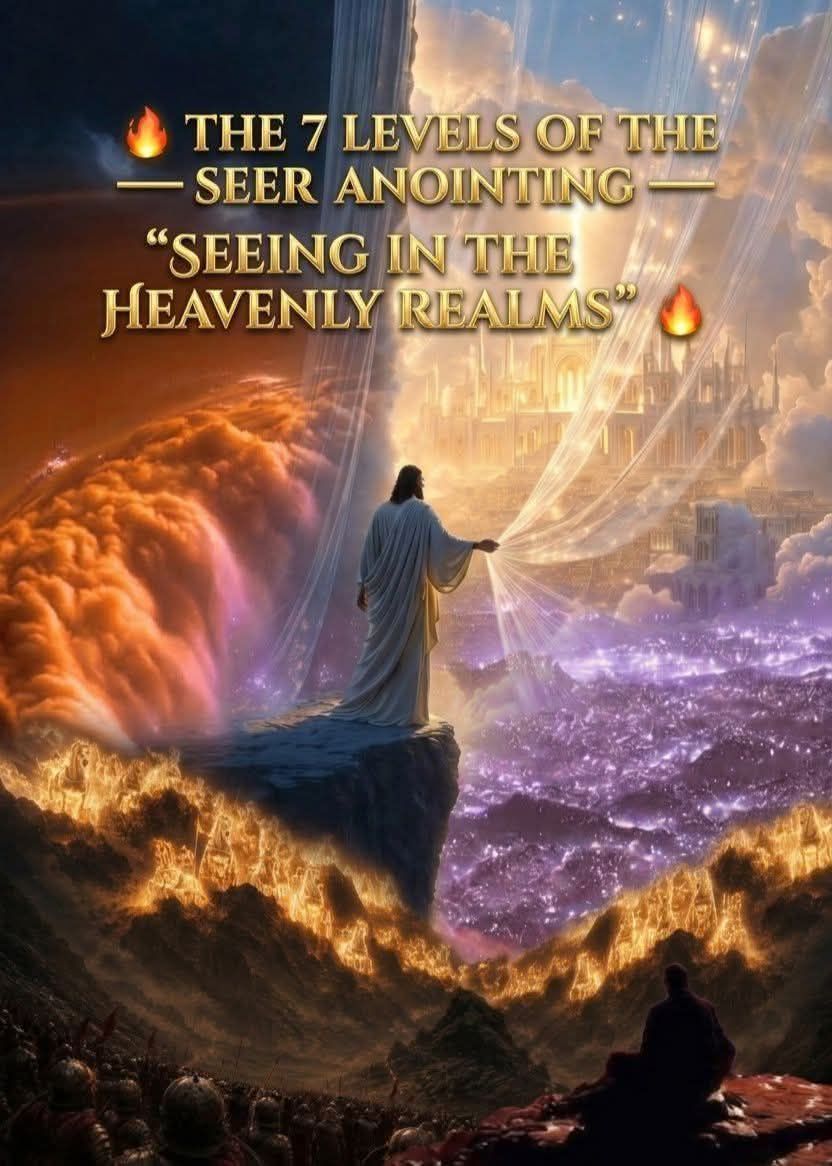
The phrase “seer anointing” is not a fixed biblical classification system, so different ministries use different frameworks. That said, in Scripture and prophetic literature, “seeing” (discernment, visions, revelation insight) appears in layers—from basic spiritual perception to rare, sovereign visions of heavenly realities.
A helpful way to understand it is as progressive levels of spiritual perception, not superiority grades. The danger is thinking it’s a status ladder; in reality, Scripture emphasizes character, obedience, and discernment over experiences.
Here’s a grounded 7-level framework:
1. Spiritual Awareness (Inner Sensitivity)
This is the earliest form of “seeing.”
You begin to notice:
inner convictions
strong impressions about situations
heightened sensitivity to right/wrong atmospheres
It’s not visions yet—it’s awakening perception.
Example principle: “The spiritual man discerns all things…” (1 Cor. 2:15)
2. Discernment of Spirits (Atmospheric Clarity)
Here, perception sharpens beyond emotions.
You begin to distinguish:
truth vs deception
peace vs oppression
motives behind actions
This is not imagination—it is evaluation through spiritual clarity.
A lot of people stop here and mistake intuition for revelation.
3. Dream Language & Symbolic Communication
At this level, God often speaks through:
symbolic dreams
patterns repeated over time
coded imagery that requires interpretation
Important: not every dream is spiritual; maturity includes filtering noise from meaning.
4. Open Vision Moments (Waking Impressions)
This is when perception becomes more vivid:
brief “mental scenes” while awake
strong internal “snapshots”
sudden understanding accompanied by imagery
Still intermittent, not constant.
Biblically, this aligns with moments like Peter’s trance in Acts 10.
5. Trance-Style Revelation (Deep Absorption States)
At this level, awareness becomes deeply focused:
physical senses may feel muted
inner perception becomes dominant
symbolic or real-time revelation unfolds internally
These experiences are rare and not self-induced in healthy biblical patterns.
6. Heavenly Realm Encounters (Structured Symbolic Realms)
Here, individuals report experiences such as:
structured symbolic “heavenly scenes”
encounters that communicate instruction, correction, or commissioning
overwhelming clarity of divine messages
However, Scripture shows these are sovereign experiences, not controllable abilities (e.g., Paul in 2 Corinthians 12).
Caution is important here: interpretation can easily be distorted by expectation or imagination.
7. Sovereign Vision Encounters (Rare Commission-Level Revelation)
This is the highest category—extremely rare and not a “developed skill.”
Characteristics:
completely God-initiated
overwhelming authority and clarity
often tied to assignment, correction, or major revelation
leaves lasting transformation, not curiosity
Even biblical prophets did not operate here constantly.
A necessary correction (this is important)
A major mistake in modern teaching is treating “seer experiences” as:
a spiritual achievement
a sign of maturity
or a predictable skill to activate
Biblically, the emphasis is different:
“Test the spirits” (1 John 4:1)
fruit of character matters more than visions
revelation without obedience becomes deception risk
A balanced conclusion
If you strip it down, “seeing in the heavenly realms” in Scripture is less about climbing levels and more about:
purified perception
surrendered will
obedient character
and God choosing when and how to reveal
The most mature “seer” in biblical terms is not the one who sees most—but the one who walks in truth with what is already revealed.


You must be logged in to post a comment.