
The “Demons” According to Paul Was the Law
When modern readers encounter Paul’s language about “spiritual forces,” they instinctively think of demons—personal, invisible beings waging war in some unseen realm. That reading is not only historically careless; it misses Paul’s argument almost entirely. In his letters, what later theology calls “demons” is far more grounded: Paul is talking about the law-driven systems and structures that once governed Israel.
The key passages—Galatians 4:9, Colossians 2:20, and Ephesians 6:12—use the phrase stoicheia tou kosmou (στοιχεῖα τοῦ κόσμου), typically translated “elemental forces of the world.” This phrase has been widely misunderstood because later Christian tradition layered demonology onto it. But in Paul’s own context, the meaning is far less mystical.
In Galatians, Paul removes all ambiguity. After warning about returning to “weak and miserable forces,” he immediately defines what he means: “You are observing special days and months and seasons and years” (Gal. 4:10). That is not demon worship—it is Torah observance. Calendar laws, ritual timing, and covenantal regulations are the very “forces” he is warning against. As James D. G. Dunn explains, Paul is criticizing “the basic principles of religious life under the law,” not supernatural beings (Dunn, The Epistle to the Galatians, 1993).
The same pattern appears in Colossians. Paul connects the “elemental forces” directly to human rules: “Do not handle! Do not taste! Do not touch!” (Col. 2:21). These are ascetic regulations—external commands imposed on behavior. N. T. Wright notes that Paul is targeting “the regulations and disciplines which marked out the old world,” not literal spirits (Wright, Colossians and Philemon, 1986). In other words, the “powers” are embedded in systems of control—religious, cultural, and social.
Even in Ephesians 6:12, often treated as proof of demonic warfare, the language reflects structured authority. Terms like archai (“rulers”) and exousiai (“authorities”) were commonly used for institutional power—governments, priesthoods, and hierarchical systems. Clinton E. Arnold acknowledges that while Paul uses cosmic language, these “powers” operate through “structures and institutions that influence human life” (Arnold, Powers of Darkness, 1992). The struggle is not against flesh and blood because it is against systems that transcend individuals—not invisible demons hiding in the air.
This reading becomes even clearer when placed within Paul’s broader theology of the law. In Galatians 3:23–25, he describes the law as a custodian—a controlling authority that held people in confinement until a new phase arrived. In Romans 7, the law is depicted as something that produces sin and death when misused. In 2 Corinthians 3, it is a “ministry of death” that is fading away. Paul consistently treats the law as a binding power, something that governs, restrains, and ultimately enslaves.
So when he speaks of being “enslaved to the elemental forces of the world” (Gal. 4:3), he is not suddenly switching topics to demons. He is continuing the same argument: life under the law was a form of bondage. To return to it is to return to slavery.
Modern demon language distorts this entirely.
The idea that Paul is describing literal demonic entities owes more to later Christian development than to the first century. As historian Elaine Pagels has shown, early Christian demonology evolved significantly over time, absorbing influences from Jewish apocalyptic traditions and Greco-Roman thought (The Origin of Satan, 1995). Paul’s letters predate much of that development. Reading full-blown medieval demonology back into his writings is historically indefensible.
There is also a conceptual problem. If Paul truly meant demons in the modern sense—independent evil beings—why does he consistently define these “forces” in terms of rules, calendars, and regulations? Why does he never describe exorcism, possession, or interaction with such entities in his letters? The silence is telling. His concern is not supernatural beings but human systems of control masquerading as divine necessity.
Walter Wink’s influential work on “the powers” captures this well: these forces are “the inner and outer aspects of institutions and structures,” not literal spirits (Naming the Powers, 1984). They are real in their effects, but they are not independent beings. They are the mechanisms through which societies organize, regulate, and dominate.
This is why calling them “demons” in the modern sense is not just inaccurate—it is misleading. It shifts the focus from structures to superstition. It turns a critique of religious and social control into a fear of invisible entities. It externalizes what Paul was trying to expose internally.
Paul’s message is straightforward when stripped of later theological baggage: the law and its associated systems once held people in bondage. Those systems had power, authority, and influence—they functioned like “rulers” over human life. But they were not divine, and they were not eternal. They were temporary structures tied to a specific covenantal world.
To go back to them, Paul argues, is to return to slavery.
So the “demons” according to Paul were not demons at all. They were the law, the systems it created, and the structures that enforced it. Mistaking that for supernatural warfare does not deepen understanding—it replaces it with mythology.
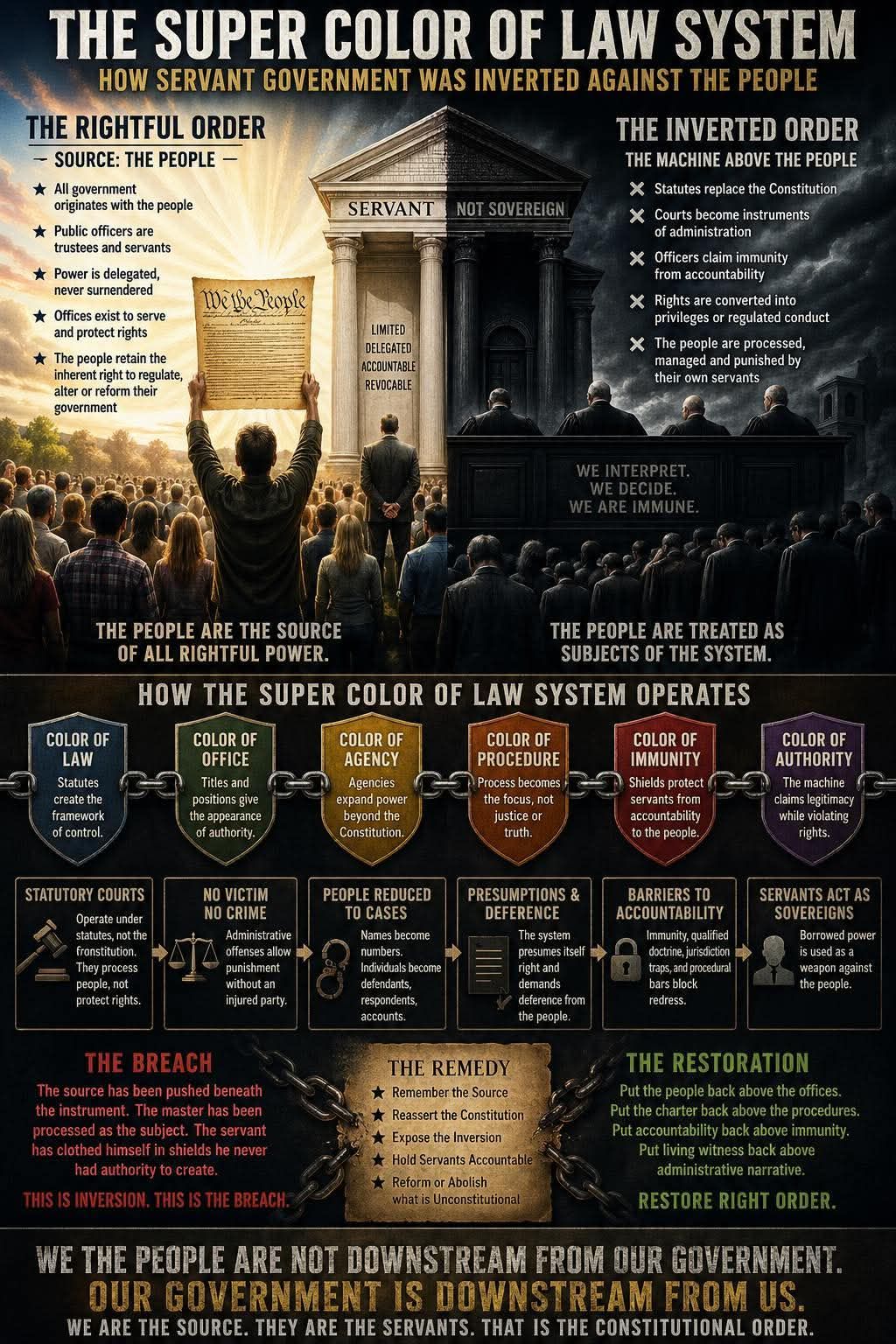
The Super Color of Law System: How Servant Government Was Inverted Against the People
We have lived so long inside the inversion that many people no longer recognize it as inversion. They call it normal. They call it process. They call it policy. They call it settled law. They call it public safety, administrative necessity, judicial efficiency, professional discretion, qualified immunity, statutory authority, and institutional legitimacy. But when all the paint is scraped off, what remains is a hard and simple truth: the people were meant to be the source, and the offices were meant to be the servants. What we have now, too often, is a system that still speaks in the people’s name while operating over the people as though the source itself were merely raw material for administration.
That is the super color of law system.
It is not just one bad officer. It is not just one bad judge. It is not just one statute, one ordinance, one agency, or one court. It is the combining of all of them into a single operating machine. Color of law. Color of office. Color of agency. Color of immunity. Color of procedure. Color of policy. Color of jurisdiction. Color of authority. Layer upon layer, each one borrowing legitimacy from the one beneath it, until the whole structure presents itself as unquestionable. Yet the more colors they stack, the harder they work to hide the original truth: they are still servants standing on borrowed ground.
The organic order was plain. The people came first. Government, of right, originated with the people. Public officers were trustees and servants of the people. That is not ornamental language. That is not ceremonial poetry. That is the source code. It means power is supposed to rise from below, not descend from above. It means the office has no life apart from the people who gave it breath. It means a judge is not a sovereign. A prosecutor is not a sovereign. A sheriff is not a sovereign. A clerk is not a sovereign. An agency is not a sovereign. They are all delegated instruments inside a structure that is only rightful to the extent it remains rooted in the people.
But that is exactly what has been turned upside down.
The inversion works like this: first, the right is acknowledged in theory. Then the exercise of that right is reclassified as a regulated activity. Then the regulated activity is enclosed in statutes, ordinances, licensing schemes, procedures, and courts. Then those courts and agencies are wrapped in doctrines of immunity, presumptions of regularity, procedural bars, jurisdictional traps, and professional deference. By the end of that process, the right is still spoken of, but the living exercise of it has been swallowed by administration. The servant has not openly abolished the source; he has simply buried the source beneath layers of color.
That is why this system feels demonic to so many people. It feeds on inversion. It takes what was meant to be a shield and turns it into a funnel. It takes what was meant to restrain power and turns it into an instrument of power. It takes the language of justice and uses it to defend process. It takes the language of safety and uses it to justify control. It takes the language of service and uses it to build a servant class that behaves like a permanent priesthood of interpretation. Everywhere you look, the same pattern appears: what was supposed to protect the people now processes the people.
The courts are one of the clearest examples. In the rightful order, a court is supposed to be a place where false claims of authority are checked, where servants are reminded of their limits, and where the charter stands above the office. But in the inverted order, the statutory court too often becomes a chamber where administrative assumptions are laundered into judgments. The people enter as source and leave as defendants, registrants, debtors, violators, respondents, or subjects of process. The issue is no longer whether the servant stayed within his original bounds. The issue becomes whether the machine moved according to its own rules. That is not republican order. That is self-referential management.
And once immunity enters the picture, the betrayal becomes even more obvious. The people did not ordain a system in which trustees could hide from the source behind shields of their own making. The very idea is upside down. A servant cannot rightfully become untouchable against the master. A delegated office cannot rise above the body that delegated it. The moment immunity is used not as a narrow protection for honest function but as a barrier against accountability to the people, it stops looking like lawful restraint and starts looking like sanctioned usurpation. It becomes one more color in the rainbow of borrowed power.
That is why these facts cannot be separated anymore. The statutes matter. The courts matter. The agencies matter. The immunity doctrines matter. The procedures matter. They are not isolated defects. Together they form a single operating environment: a super color of law system that survives by making the people feel small, fragmented, and downstream. It survives by forcing the source body to speak in lower categories while the offices speak in higher tones. It survives by convincing the people that they are private units inside a superior machine, instead of the living body from which all rightful government proceeds.
The answer is not despair. The answer is witness.
We have to say what happened in plain language. The people were reduced below their servants. Rights were converted into administrable conduct. Courts increasingly protected process more than source. Public offices borrowed the language of service while constructing barriers against accountability. The machine became self-referencing, self-defending, and self-expanding. That is the breach.
Once that breach is named, the next step is not to mimic the machine. It is to restore the order the machine inverted. Put the people back above the offices. Put the charter back above the procedures. Put accountability back above immunity. Put living witness back above administrative narrative. Put constitutional memory back above institutional habit.
The point is not chaos. The point is right order.
The people are still the source. The servants are still only servants. Borrowed authority is still borrowed authority. No amount of robes, seals, badges, forms, policies, or doctrines can change that first truth. The machine can paint itself in a thousand colors, but color is not substance. The office still stands on delegated ground. And when the people remember that, the spell begins to break.


You must be logged in to post a comment.