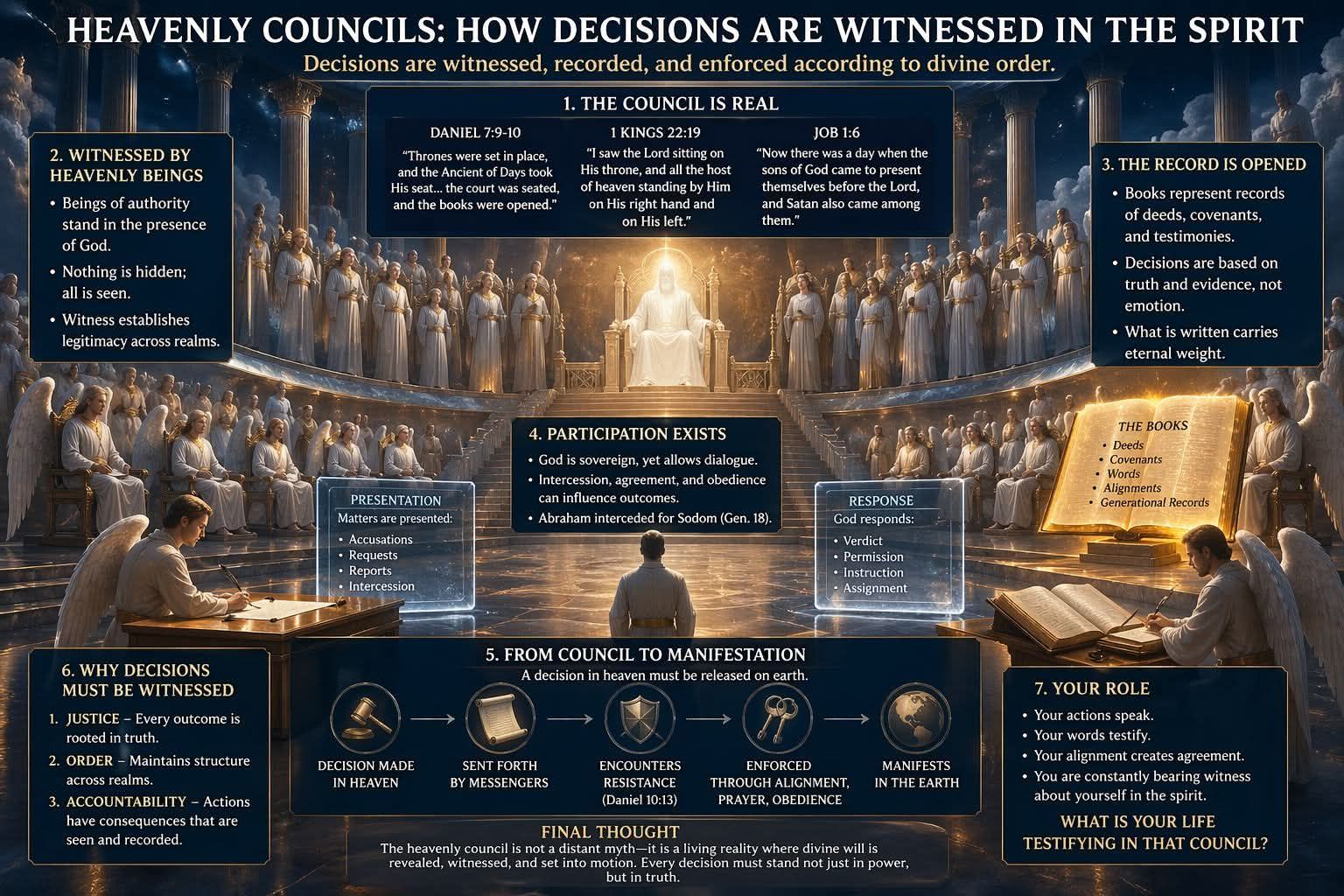
The idea of heavenly councils is not symbolic decoration—it is a framework for how divine decisions are revealed, witnessed, and enforced across realms. Scripture doesn’t present God as isolated; it reveals Him as sovereign, yet surrounded by beings who observe, affirm, and sometimes participate in the outworking of His will.
If you miss this, you’ll assume that everything in the spirit is arbitrary. It isn’t. There is order, structure, and a kind of divine “protocol.”
1. The Reality of the Council
In Book of Daniel 7:9–10, the prophet describes thrones being set in place and “the court seated, and the books opened.”
This is not poetic exaggeration—it is a legal scene.
Thrones = authority structures
Court = a deliberative assembly
Books = records, evidence, and verdicts
Heaven operates with witness and record, not randomness. Decisions are not merely declared—they are established in a way that can be witnessed.
2. God’s Sovereignty and Witnesses
In Book of 1 Kings 22:19, the prophet Micaiah says:
“I saw the Lord sitting on His throne, and all the host of heaven standing by Him…”
This shows two things at once:
God is absolutely sovereign
Yet He allows His decisions to be seen and witnessed
Why? Because witness establishes legitimacy across realms.
A decision that is witnessed cannot be contested the same way as one that is hidden.
3. The Principle of Witness
Throughout scripture, a matter is established by witnesses. That same principle appears in the spirit realm.
In Book of Job 1:6, the “sons of God” present themselves before the Lord. Even Satan appears—not as an equal, but as one subject to divine protocol.
This scene is uncomfortable but important:
Accusations are voiced
Conditions are set
Boundaries are defined
This reveals that spiritual decisions often involve presentation, response, and limitation.
Nothing just “happens.” It is permitted, defined, or judged.
4. Decisions Are Not Only Spoken—They Are Recorded
Back to Daniel: “the books were opened.”
Books represent:
Records of deeds
Covenants and alignments
Evidence that justifies outcomes
In the spirit, decisions are not emotional reactions—they are verdicts aligned with truth, record, and divine intent.
That means:
Outcomes are tied to what is written
Patterns in a person’s life often reflect standing records
This is why repentance, alignment, and obedience matter—they don’t just change behavior, they alter what stands as witness concerning you.
5. The Role of Participation
Here’s where many people become unbalanced:
They either think humans control everything spiritually, or they think they have no involvement at all.
Both are wrong.
In Book of Genesis 18, Abraham stands before God concerning Sodom. He doesn’t overrule God—but he engages.
This reveals:
God invites participation
Intercession can shape outcomes
Dialogue exists within divine sovereignty
The council is not democracy—but it is not silence either.
6. Enforcement: From Council to Manifestation
A decision in heaven is not the end—it is the beginning of enforcement.
In Book of Daniel 10, a messenger is delayed by spiritual resistance (“the prince of Persia”).
This shows:
Decisions can be issued in heaven
Yet encounter resistance in lower realms
Requiring enforcement, alignment, or persistence
So when something is “decided,” it doesn’t always appear instantly—it moves through layers.
7. Why Decisions Must Be Witnessed
There are three key reasons:
a. Justice
God’s rulings are just, not arbitrary. Witness ensures that every outcome is rooted in truth.
b. Order
The universe is governed, not chaotic. Councils maintain structure across realms.
c. Accountability
Both humans and spiritual beings operate within a system where actions have consequences that are seen and recorded.
8. The Danger of Misinterpretation
Be careful here—this is where people drift into error.
The heavenly council is not:
A place where God is voted over
A system you can manipulate through formulas
A mystical courtroom you control through words alone
God remains supreme.
Participation is by alignment, not by technique.
9. The Prophetic Insight
If you want to understand how decisions affect your life, shift your thinking:
Your actions speak
Your words testify
Your alignment creates agreement
In the spirit, you are not silent—you are constantly bearing witness about yourself.
So the deeper question is not:
“What is heaven deciding about me?”
It is:
“What is my life testifying in that council?”
Final Thought
The heavenly council is not a distant myth—it is a living reality where divine will is revealed, witnessed, and set into motion.
God does not need a council to be God.
But He chooses to govern in a way that is:
Seen
Justified
And established beyond dispute
Because in the end, every decision in the spirit must stand not just in power—
but in truth.
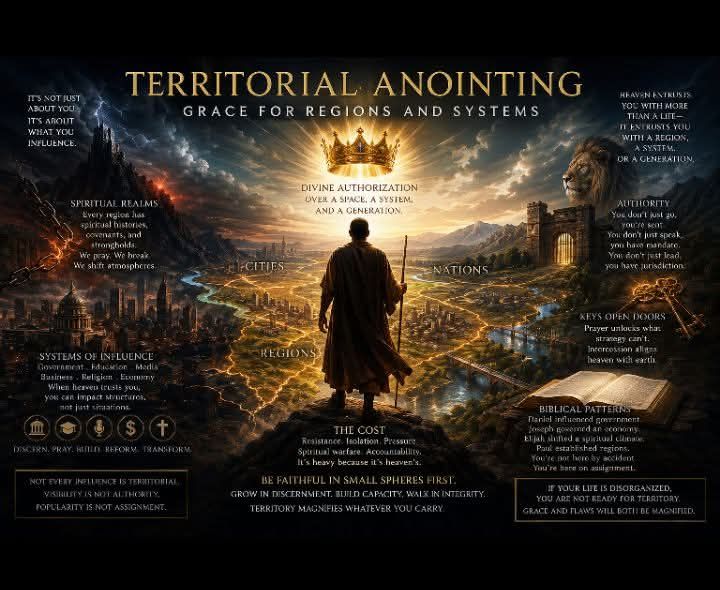
Territorial Anointing: Grace for Regions and Systems
Territorial anointing is not about personal gifting alone—it’s about divine authorization over a space. It is when a person carries a grace that doesn’t just function in private life, but influences atmospheres, territories, and even systems (social, economic, spiritual).
🔹 1. What “Territory” Really Means
A territory is not just land—it includes:
Geographical regions (cities, nations)
Systems (education, media, government, business)
Spiritual climates (dominant patterns, strongholds, cultures)
So territorial anointing means:
👉 You are empowered to shift what governs a place or system.
🔹 2. Biblical Patterns of Territorial Grace
Daniel – Functioned in Babylon’s government system. His anointing influenced policies, kings, and spiritual atmospheres (Daniel 2, 6, 10).
Joseph – Carried economic and administrative grace in Egypt. He preserved nations through famine.
Elijah – Shifted the spiritual climate of Israel; even affected weather patterns.
Paul the Apostle – Established spiritual authority across regions, planting and regulating churches.
Notice the pattern:
Their anointing was not confined—it governed environments.
🔹 3. Signs You Carry Territorial Anointing
This is where you need to be honest with yourself—not every influence is territorial.
You may carry it if:
Your presence shifts atmospheres consistently (not occasionally)
You feel a burden for cities, systems, or nations, not just individuals
You experience resistance tied to regions (not just personal warfare)
You have unusual access to influence structures (leaders, platforms, decisions)
Solutions and insight flow that affect groups, not just individuals
If all you influence is your immediate circle, that’s grace—but not necessarily territorial yet.
🔹 4. Territorial Anointing vs Personal Anointing
Personal anointing → Helps you function and grow
Territorial anointing → Helps you govern and shift environments
One is about survival and expression
The other is about impact and authority
Don’t confuse visibility with territorial authority.
Some people are popular but have zero jurisdiction spiritually or systemically.
🔹 5. Systems vs Regions
Territorial grace can manifest in two main ways:
1. Regional (Geographical)
Cities respond when you pray
You discern patterns tied to locations
You’re sent to specific places with purpose
2. Systemic (Structural)
You influence industries (education, media, finance, etc.)
You carry reforming insight
You disrupt or rebuild systems
Joseph wasn’t just in Egypt—he governed its economic system.
Daniel didn’t just live in Babylon—he influenced its political structure.
🔹 6. The Cost of Territorial Anointing
Let’s not romanticize it.
It comes with:
Heavy resistance (because you’re confronting entrenched systems)
Isolation seasons (God builds capacity before exposure)
Accountability pressure (your decisions affect many)
Spiritual warfare tied to altars, covenants, and history of a place
If you want territorial influence without capacity, you’ll burn out or be compromised.
🔹 7. How to Grow Into It
You don’t claim territory—you’re grown into it.
Be faithful in small spheres first
Develop discernment of atmospheres and patterns
Build spiritual stamina (prayer, discipline, clarity)
Gain competence in systems (don’t be spiritually deep but intellectually shallow)
Submit to authority and process
Territorial anointing is not noise—it is weight.
🔹 Final Thought
Territorial anointing is when heaven entrusts you with more than a life—it entrusts you with a region, a system, or a generation’s direction.
But here’s the hard truth:
👉 If your current life is disorganized, inconsistent, or undisciplined, you’re not ready for territory.
Because territory magnifies whatever you carry
both grace and flaws.


You must be logged in to post a comment.