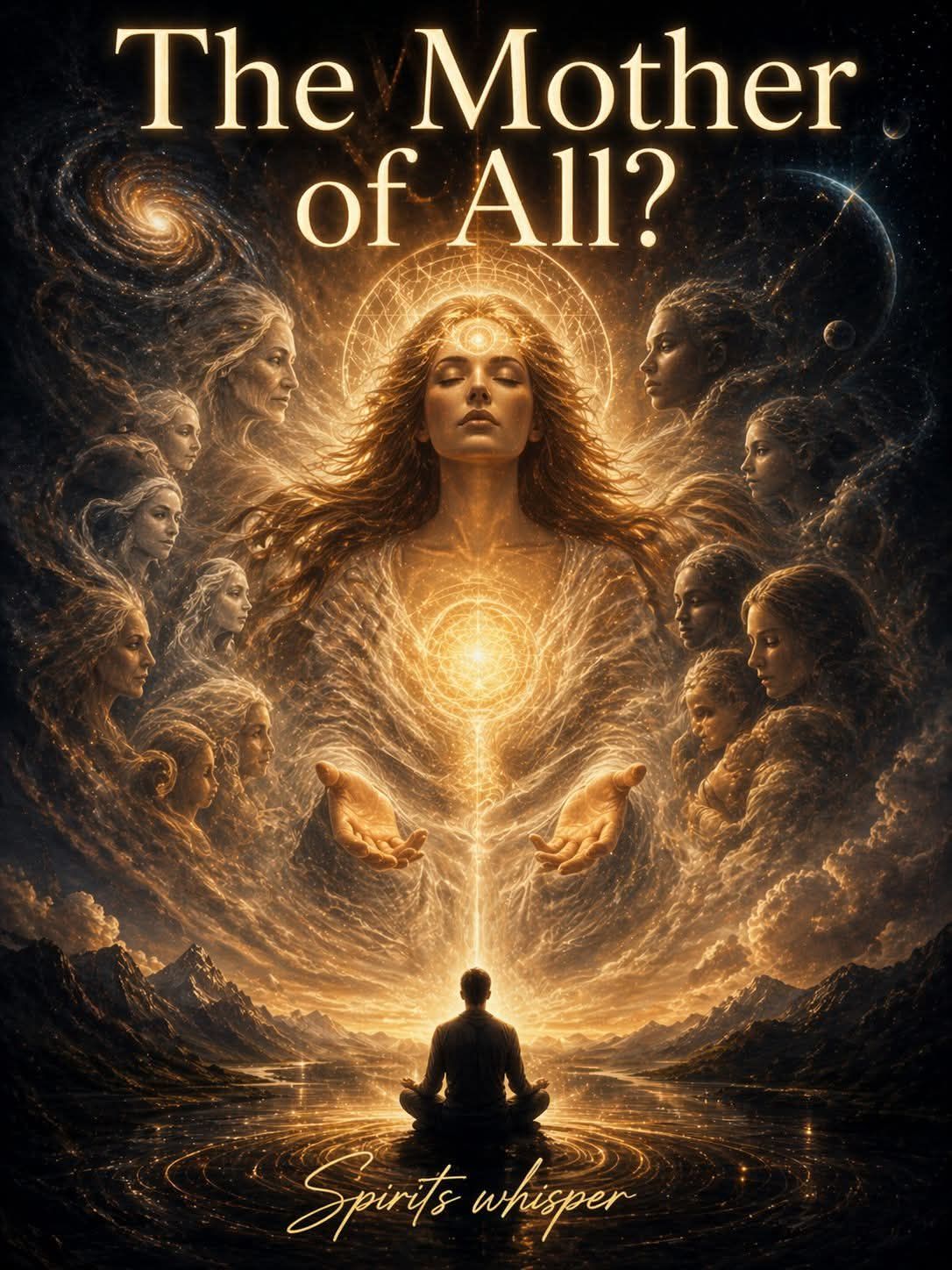
There are words that make religion nervous.
Not because they are automatically evil.
Not because they are automatically false.
But because they point toward rooms most people were told never to enter.
Words like mētēr tōn pantōn.
Mother of All.
Words like Protennoia.
First Thought.
Words like Trimorphic Protennoia.
The Three Forms of First Thought.
Words like Barbelo.
And the moment many people hear them, fear rises.
But fear is not discernment.
Fear is often just the boundary marker of inherited control.
So let’s slow down and look.
Mētēr tōn pantōn means Mother of All.
Just sit with that.
Mother of All.
Why does that shake people?
Maybe because we have been trained inside systems that made everything about masculine hierarchy, masculine authority, masculine imagery, masculine mediation, masculine structure, and masculine permission.
Then we wonder why there is so little transformation.
We wonder why there is so much division.
Why so much striving.
Why so much domination.
Why so much performance.
Why so much theology and so little birth.
But everything that comes into this world comes through a womb.
That does not make the feminine superior to the masculine.
It means creation itself is already testifying that life enters through reception, formation, nurture, hiddenness, and birth.
Through a womb.
So when people ask,
What came first, the chicken or the egg?
I hear a deeper question.
What did we erase in our telling of God?
What dimension of divine reality did we become afraid of?
What if part of the reason so much of orthodoxy produces conformity without transformation is because it over-centered the masculine and muted the feminine?
What if we kept the throne language but lost the womb language?
What if we kept authority but lost gestation?
What if we kept law but lost nurture?
What if we kept pronouncement but lost birth?
Then of course people would know how to argue,
but not how to become.
That is where words like Protennoia and Barbelo start becoming provocative.
Protennoia means First Thought.
Not your anxious thought.
Not your looping thought.
Not your divided thought.
First Thought.
The originating Thought.
The primal knowing.
The first movement of divine self-expression.
And in Trimorphic Protennoia, this First Thought speaks.
Not as a dry concept.
Not as a footnote.
But as a living voice.
A revealing voice.
A birthing voice.
A descending voice.
A gathering voice.
And this is where Barbelo comes in.
Barbelo, in these ancient streams, is often understood as the first emanation, the first outshining, the first self-disclosure of the Invisible Spirit.
People have called Barbelo forethought.
They have called Barbelo first thought.
They have called Barbelo the womb of fullness.
They have called Barbelo the Mother-Father.
They have called Barbelo the luminous matrix through which manifestation begins.
Now, can I prove every theological implication of that to a courtroom standard?
No.
And I do not need to pretend that I can.
But I can say this:
the very existence of these streams tells us that not all early followers and seekers experienced divine reality through the narrow categories that later orthodoxy standardized.
That matters.
Because once you know that, you stop acting like the final doctrinal system handed to you is the only language humanity ever had for the sacred.
And maybe that is exactly why these things disturb people.
Not because they are dangerous in themselves,
but because they expose that the story was bigger than we were told.
Now, let me be careful.
I am not saying,
Throw everything out.
I am not saying,
Every hidden text is pure.
I am not saying,
Whatever is strange must be true.
I am saying:
if in all our getting we are to get understanding,
then we should not be afraid to look.
Especially when fear itself was one of the main tools used to keep people from looking.
For most of my life, I was told there were things you do not touch,
things you do not read,
things you do not question,
things you do not explore.
And the fear was intense.
But the Spirit does not lead by fear.
The Spirit leads by truth.
And if the Spirit is trying to remove all fear,
then some of what we call danger may simply be the discomfort of stepping beyond inherited walls.
That does not mean we become gullible.
It means we become honest.
Honest enough to admit that truth can offend the ego.
Honest enough to admit that cognitive dissonance is not always the devil.
Honest enough to admit that being triggered is often a sign that something deeper is being touched.
Because those who live in the great law of God are not ruled by offense.
Why?
Because love is not terrified of enlargement.
Truth is not afraid of examination.
Wisdom is not threatened by deeper seeing.
And maybe that is part of what is happening here.
Maybe the offense comes because people built their entire world on an incomplete image of God.
A heavily masculinized image.
A flattened image.
A controlled image.
A sanctioned image.
And when language of Mother, womb, first thought, emanation, and feminine fullness appears,
it does not merely challenge a doctrine.
It challenges an entire psychic architecture.
It challenges who gets to speak for God.
It challenges who gets to represent God.
It challenges the assumption that divine fullness can be reduced to male-coded authority structures.
And listen:
I am not living without the feminine.
I am not interested in a spirituality that amputates half the mystery.
I am not interested in a theology that can command but cannot conceive.
I am not interested in a God-language that knows how to rule but not how to birth.
Because if there is no womb,
there is no appearing.
If there is no hiddenness,
there is no formation.
If there is no receptivity,
there is no incarnation.
Something in us knows this.
That is why these words pull on people, even if they do not fully understand them yet.
Mother of All.
First Thought.
Three Forms of First Thought.
Barbelo.
These are not just exotic terms.
They are signposts.
They are invitations to remember that divine reality may be more spacious, more radiant, more maternal, more interior, and more alive than the systems we inherited allowed.
And were these ideas “taken out of Scripture”?
Maybe not in the simplistic sense people usually mean.
Maybe the deeper truth is that one stream got canonized and another stream got sidelined.
One vocabulary was preserved in the center, and another was pushed to the margins.
One way of narrating divine order was called safe, and another was called dangerous.
And once power gets involved, that is never accidental.
Because control prefers a narrow God.
Control prefers sanctioned language.
Control prefers a heaven with gatekeepers.
Control prefers a canon that can be monopolized.
But the living Spirit keeps breaking out of boxes.
The living Spirit keeps leading people into places they were told not to go.
The living Spirit keeps illuminating what fear tried to bury.
The living Spirit keeps calling people beyond the stale certainty of borrowed conclusions.
So no, I am not afraid of these words.
I am listening.
I am discerning.
I am letting them ask me questions.
Not because I worship novelty,
but because I worship truth.
And truth has never been threatened by honest seeking.
So maybe the real issue is not whether these words sound orthodox enough.
Maybe the real issue is this:
Can we allow ourselves to be led into deeper understanding,
even when it unsettles what we thought was complete?
Can we let the Spirit reveal dimensions we were told were forbidden?
Can we admit that part of the fracture in religion may come from suppressing the feminine face of divine disclosure?
Can we acknowledge that birth, wisdom, hiddenness, receptivity, and first thought matter?
Because if we cannot,
then we may keep defending a God we were handed
while resisting the God who is still unveiling.
And I would rather be offended into truth
than comforted inside distortion.
I would rather walk through the dissonance and come into deeper seeing
than cling to inherited fear and call it discernment.
So let us talk about Mother of All.
Let us talk about First Thought.
Let us talk about Barbelo.
Let us talk about what was centered,
what was marginalized,
what was canonized,
what was feared,
and what still whispers beneath the surface.
Because maybe the question is not just,
What was left out?
Maybe the deeper question is,
What in us was never allowed to come forth?
And maybe part of healing is letting it be born.
Do not fear the doorway that asks you to see more deeply.
What is true will not collapse under honest light.
Let wisdom unsettle what fear built in you.
The womb of God is not your enemy.
Be still enough to let deeper understanding come forth.


You must be logged in to post a comment.