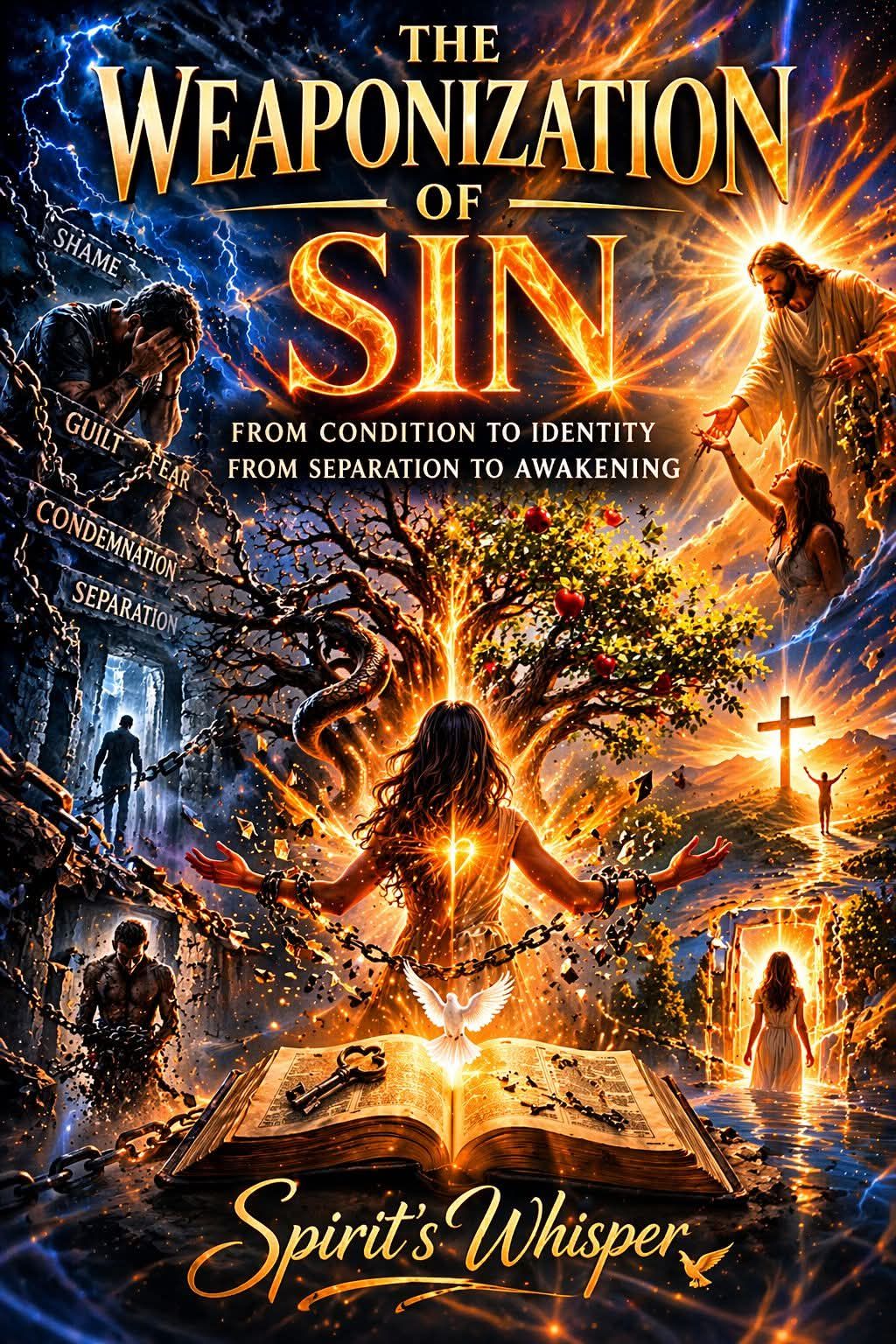
The English word sin is not the original word.
It came into English through Old English and Germanic language streams, where it carried ideas like wrongdoing, guilt, offense, injury, even feud.
But when we go back to Scripture itself, the language is deeper.
In Hebrew, one of the main words translated as sin is chata.
It carries the sense of missing, missing the way, missing the mark, falling out of alignment.
In Greek, hamartia carries that same kind of range:
failure, error, wandering from the path, missing the mark.
That already tells us something important.
Sin was not originally framed as your identity.
It was describing a distortion.
A deviation.
A condition.
A state of missing what you were made for.
That is why Scripture can speak of sin not only as acts, but as a power.
Paul says sin entered the world through one man, and death through sin.
Then he speaks of sin reigning.
Jesus says whoever practices sin becomes a slave of sin.
A slave is not being described there as someone expressing their truest essence.
A slave is someone in bondage.
That is the point.
Sin is not the revelation of who you are.
It is the evidence that something has gone wrong in consciousness, desire, alignment, and union.
Adam is the pattern.
People read, “in the day you eat of it you shall surely die,” and because they read only through the natural mind, they assume that must mean physical death alone.
But Adam did not fall over physically that day.
Something deeper happened.
He moved into hiding.
Into fear.
Into shame.
Into estrangement in perception.
Into accusation.
Into toil.
Into exile in awareness.
And Scripture itself confirms this larger meaning of death.
Jesus says the one who hears His word and believes has passed from death unto life.
Not will pass one day.
Has passed.
Paul says the carnal mind is death, but the mind of the Spirit is life and peace.
So death in Scripture is not merely a body in a grave.
Death is a present condition of separation-consciousness.
A state where the soul is out of harmony with Life itself.
That is why sin became so easy to weaponize.
Once religion lost the mystery of sin as condition, captivity, blindness, and misalignment, it turned sin into a permanent label.
Instead of saying, “You are in bondage,”
it said, “This is who you are.”
Instead of saying, “You have missed the way,”
it said, “You are filth.”
Instead of saying, “You are living from the tree of separation and it is producing death in your awareness,” it said, “God’s main relationship to you is disgust.”
But that is not the movement of Scripture.
Scripture says God is married to the backslider.
That is covenant language.
Not paperwork.
Not modern contract language.
Not the fragile arrangements people make and break in the flesh.
It is the language of a God who refuses to abandon what came forth from Him.
And that is why the whole eternal-conscious-torment framework collapses under the weight of union.
People imagine a God who will eternally torture the very life that came forth within His own creation because they still think in separation.
They still imagine God over there,
humanity over here,
judgment later,
heaven later,
hell later,
life later.
But Jesus said the one who hears His word passes from judgment unto life.
That means judgment is not merely future.
It is already built into reality.
To live from illusion is judgment.
To live from division is judgment.
To live from the carnal mind is judgment.
To live from accusation, shame, fear, and estrangement is judgment.
And to awaken into union, truth, love, and life is to pass through that judgment into life now.
So no, sin is not best understood as your identity.
Sin is what happens when identity is forgotten.
It is what happens when a being made for communion begins living from fracture.
When one made for wholeness begins feeding on separation.
When one made for Life starts drawing from a mind that can only produce death.
That is why the answer to sin is not mere behavior management.
The answer is awakening.
Healing.
Reconciliation.
Renewing of the mind.
Deliverance from the lie of separation.
The restoration of right seeing.
Religion often says:
“You are a sinner, now spend your life trying to prove you are not.”
The Spirit says:
“You have lived beneath your origin. Wake up. Return. Remember who and whose you are.”
Sin was weaponized when it stopped being treated as bondage and started being used as identity.
When it stopped being something Christ came to destroy and started being the name religion needed people to wear.
But Christ did not come to merely manage sinners.
He came to take away the sin of the world.
To break its reign.
To end its dominion.
To restore what was lost in Adamic consciousness.
To bring us out of death and into Life.
That is not a courtroom trick.
That is the healing of reality within the human being.
The deepest judgment is separation.
The deepest mercy is awakening.
And the deepest redemption is not that God changed His mind about you,
but that in Christ, you are being brought back into Life.


You must be logged in to post a comment.