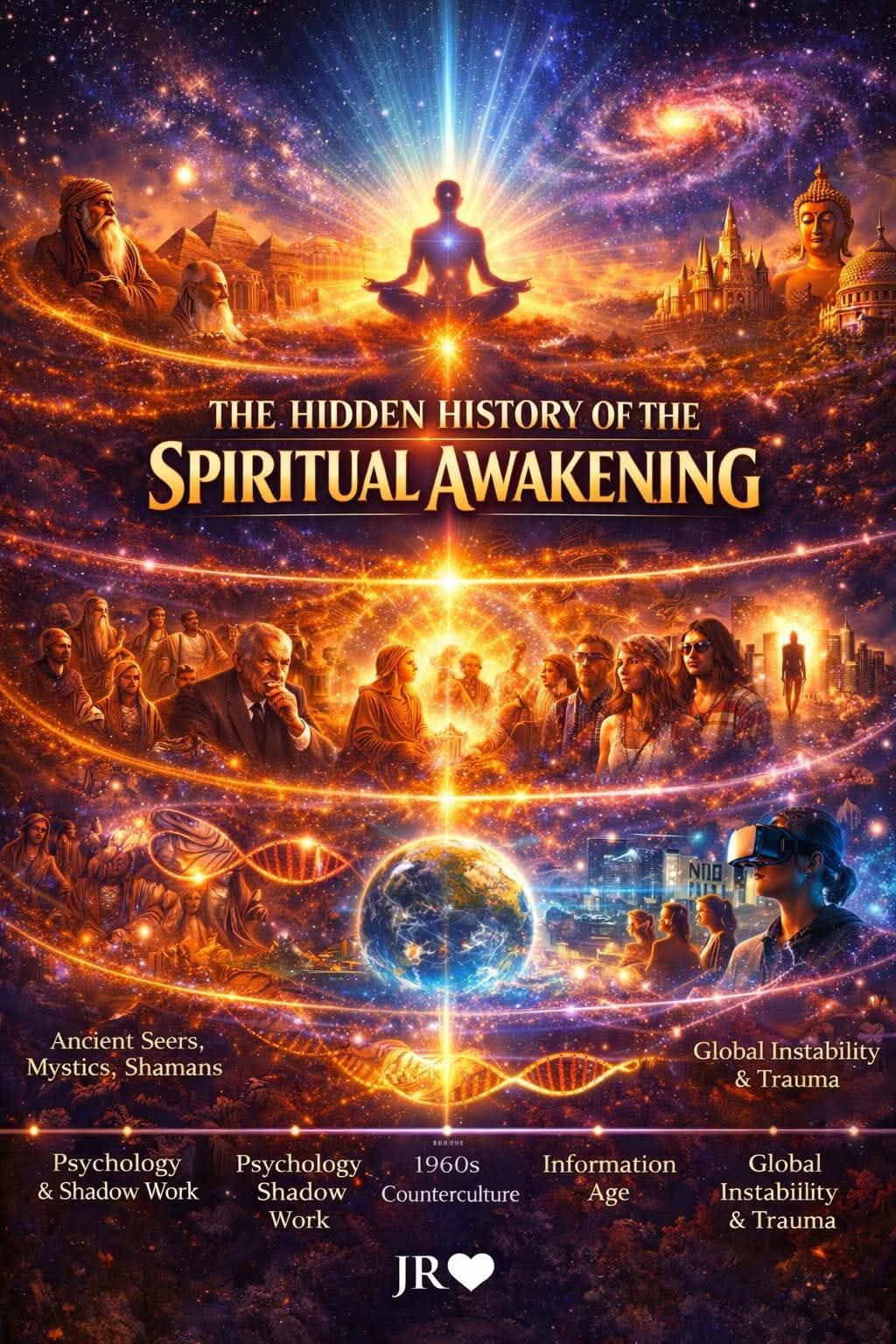
What people call the spiritual awakening did not begin with trends, hashtags, or modern wellness culture.
It began the moment human beings started sensing that existence held something deeper than survival, status, and repetition.
The awakening has moved through history in waves.
It began with the first mystics, shamans, seers, and sages.
Long before organized systems were built, there were those who entered silence, watched the stars, listened to dreams, fasted, prayed, and discovered that consciousness itself was a doorway. They understood that life was not only physical, and that the visible world was only part of reality.
Then came the great spiritual traditions.
Hinduism, Buddhism, Taoism, mystical Christianity, Sufism, Kabbalah, indigenous wisdom paths, and sacred esoteric schools each preserved pieces of a much older remembering. Beneath their outer forms was the same essential truth: the human being is more than the ego, and awakening begins when the inner life becomes more real than the mask we show the world.
Then truth became institutionalized.
Religion, once born from revelation, was often fused with power, hierarchy, and control. Direct experience became replaced by doctrine. Living wisdom became ritual. Yet even when the sacred was hidden beneath structure, it never disappeared. It survived through mystics, hermits, poets, healers, visionaries, and those who carried the inner fire in silence.
Then came the rise of modern materialism.
Science, industry, and technology transformed civilization. Humanity learned how to measure, build, and control the external world. But in the process, many became cut off from the inner world. This was one of the major catalysts of awakening: people began gaining more externally while feeling more empty internally.
Then the doors started reopening.
Eastern teachings began moving into the Western world.
Meditation, yoga, non-attachment, karma, breath, stillness, and consciousness itself entered broader cultural awareness. Ancient practices that were once hidden or distant began reaching ordinary people searching for something deeper than success and consumption.
Then psychology changed the conversation.
Carl Jung and others helped reveal that awakening is not only about transcendence, but also about shadow, projection, archetypes, inner fragmentation, and integration. This was a major turning point, because it showed that spirituality without inner honesty can become another illusion.
Then came the rebellion of the 1960s and 70s.
People began questioning authority, war, rigid systems, empty tradition, and purely material definitions of life. Meditation, psychedelics, spiritual experimentation, communal living, energy work, and consciousness exploration entered mainstream awareness. The awakening moved from secret circles into public culture.
Then came the information age.
The internet broke open access to teachings that once belonged only to monasteries, mystery schools, rare books, or isolated teachers. Suddenly millions could explore near-death experiences, sacred geometry, breathwork, trauma healing, ancient texts, spiritual philosophy, and consciousness studies from anywhere in the world.
Then came collective suffering.
Heartbreak. Betrayal. Burnout. Anxiety. Depression. Trauma. Loss of meaning. Global instability. These became hidden engines of awakening. Many people did not begin seeking truth because life was easy. They began seeking because the old way of living stopped working. Pain became the portal. Collapse became the initiation.
Then spirituality exploded online.
Healing, manifestation, shadow work, divine feminine and masculine energy, nervous system regulation, ascension, synchronicity, soul contracts, and nonduality became common language. Some of this has been distorted. Some of it has become performance. Some of it is ego using sacred vocabulary. But beneath all the noise, something real is still happening:
Humanity is remembering that life is not only about surviving the world.
It is about becoming conscious within it.
The real spiritual awakening is not aesthetic.
It is not about collecting spiritual language, symbols, or identities.
It is the moment a person sees that the false self cannot carry them any further.
It is when success without truth begins to feel empty.
It is when trauma becomes conscious enough to stop repeating itself.
It is when the soul becomes more important than the role.
It is when a person stops trying to dominate life and starts asking what life is revealing through them.
The hidden history of the spiritual awakening is really the hidden history of the human soul refusing to disappear.
It is the return of inner authority.
The return of direct experience.
The return of sacred intelligence.
The return of the soul after centuries of distraction.
And the major events that shaped this awakening were not only historical.
They were deeply personal too.
The collapse of certainty.
The failure of material success to fulfill the heart.
The hardening of religion into form without spirit.
The return of eastern wisdom.
The rise of psychology and shadow work.
The rebellion against dead systems.
The spread of truth through technology.
The pressure of collective suffering.
And the realization in millions of people that without consciousness, nothing external is enough.
That is why this movement keeps growing.
Because awakening is not a trend.
It is the soul refusing to remain asleep in a world built on forgetting.
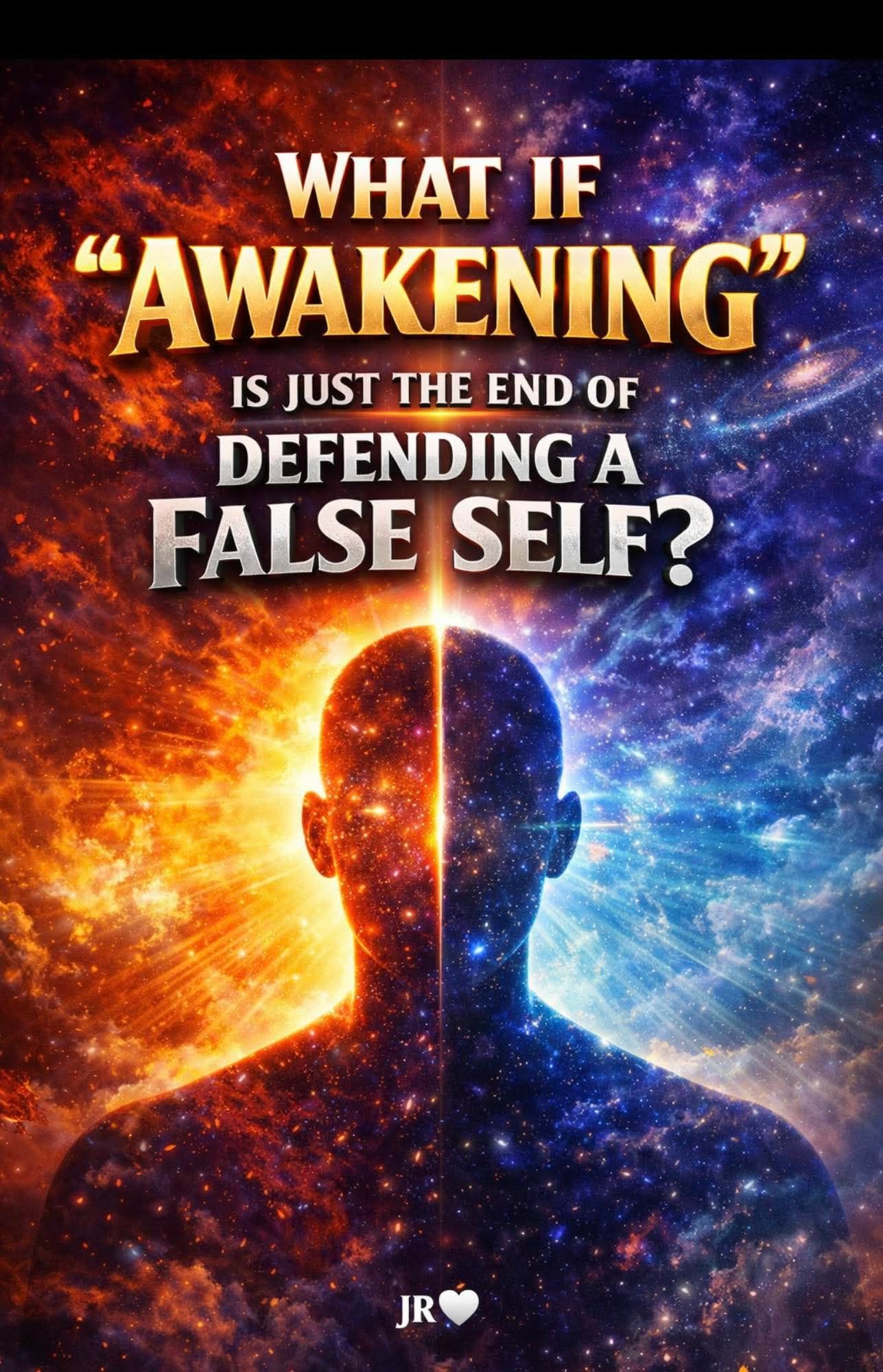
What if “awakening” is not about becoming more spiritual…
but about finally getting tired of protecting what was never really you?
Most people imagine awakening as a gain.
More light.
More truth.
More power.
More peace.
But often, awakening begins as a loss.
The loss of the mask.
The loss of the performance.
The loss of the identity that was built to survive pain, win approval, avoid rejection, and stay in control.
The false self is not evil.
It is a defense system.
It is the version of you that learned:
“If I act this way, I’ll be loved.”
“If I hide this part, I’ll be safe.”
“If I stay strong, pleasing, intelligent, spiritual, successful, or needed… I can avoid being hurt.”
So the false self is not just a lie.
It is frozen intelligence.
A strategy built out of memory, fear, and adaptation.
And this is why awakening can feel so uncomfortable.
Because it does not just reveal truth.
It exposes what you have been using to avoid truth.
It shows you where your personality became armor.
Where your confidence became compensation.
Where your kindness became self-erasure.
Where your spirituality became another identity to protect.
Real awakening is not always luminous at first.
Sometimes it feels like exhaustion.
Exhaustion from pretending.
Exhaustion from managing appearances.
Exhaustion from carrying an image that no longer fits your soul.
There comes a point where the inner being can no longer breathe inside the structure the ego built.
And that breaking point is sacred.
Because the moment you stop defending the false self, something deeper begins to emerge.
Not a better costume.
Not a more impressive persona.
But presence.
A quieter self.
A truer self.
A self that does not need constant validation because it is no longer built from comparison.
A self that does not need to dominate or disappear.
A self that is no longer asking,
“How do I seem?”
but
“What is real?”
That is when awakening becomes less about special experiences and more about radical honesty.
You stop asking how to ascend while still clinging to the identity that was built in separation.
You stop decorating the ego with spiritual language.
You stop confusing image with essence.
And slowly, what remains is not emptiness.
It is you before distortion.
You beneath the defense.
You without the negotiation.
Maybe awakening is not the achievement of a higher self.
Maybe it is the collapse of everything false that kept your real self hidden.
And maybe the reason it feels like death…
is because something unreal is finally being asked to end.
 Grace Watcher Network
You must be logged in to post a comment.