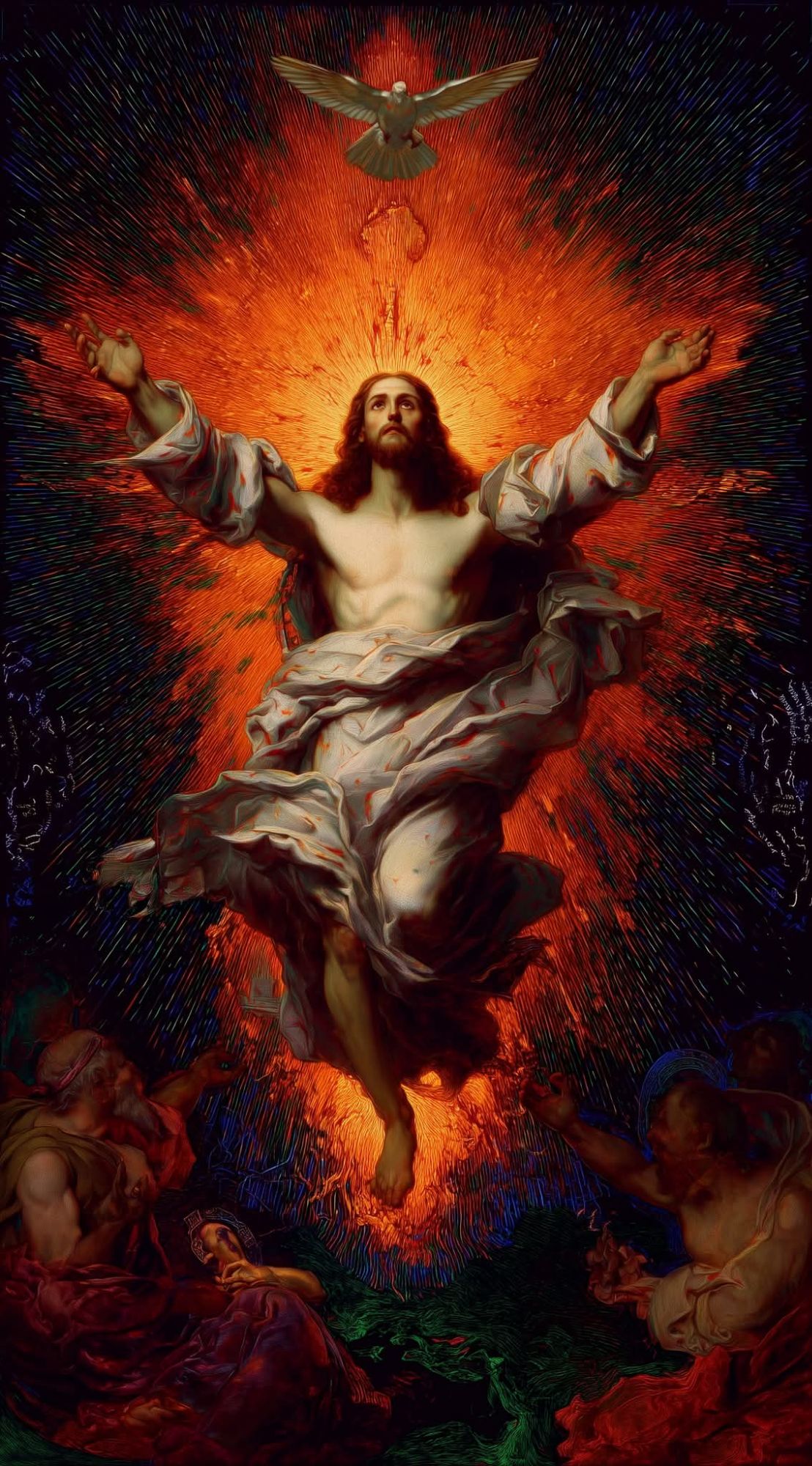
Most traditions teach the Ascension of Christ as a supernatural departure. A divine being rises into the sky, disappears behind clouds, and leaves humanity behind to wait. This reading is comfortable, but it is shallow. The esoteric traditions insist on something far more unsettling. The Ascension was not a movement through space. It was a movement of consciousness.
In the ancient mystery schools, ascension never meant going upward physically. It meant the elevation of awareness beyond the density of material identification. To ascend was to withdraw identity from the flesh, the emotions, and the conditioned mind, and to anchor it in the luminous intelligence behind form. Christ did not leave the world. He exited the limits of perception that define what the world appears to be.
The cloud that receives Christ is not meteorological. In Hebrew mysticism, the cloud is the veil of unknowing, the same cloud that covered Sinai, the same obscurity that hides the divine presence from unprepared consciousness. Ascension into the cloud means entry into the superconscious state where form dissolves into principle and personality dissolves into Logos.
The disciples do not ascend with him because ascension is never collective by force. Inner alchemy cannot be inherited. Each consciousness must transmute its own lead into gold. This is why Christ tells them to wait. Not for power from outside, but for ignition from within. The fire of Pentecost is not separate from the Ascension. One is the departure of the Master state. The other is its replication within the many.
In Gnostic traditions, the Ascension represents the return of the divine spark through the planetary spheres. Each sphere strips away an illusion. Authority. Fear. Identity. Time. Desire. Death. When Christ ascends, he passes through these layers, not as a body traveling upward, but as consciousness shedding its attachments. This is why death could not hold him. Death only binds what still identifies with form.
Alchemy encodes the same mystery. The Ascension is the final stage of the Magnum Opus. After nigredo, albedo, and rubedo comes sublimatio. The rising of the refined essence. The volatile freed from the fixed. Christ’s body becomes light because the gross elements have already been purified. Resurrection prepares the vessel. Ascension dissolves the vessel.
This is why the Ascension terrifies religious authority. A Christ who leaves the sky remains untouchable. A Christ who ascends within consciousness becomes reproducible. If Ascension is internal, then salvation is not mediated. The kingdom is not postponed. The divine is not distant. The human being becomes the temple where heaven and earth reconcile.
The angels who ask “Why do you stand looking upward?” are not offering comfort. They are issuing a rebuke. Stop externalizing transcendence. Stop gazing at the sky. The same consciousness that ascended is meant to awaken in you. Not symbolically. Not metaphorically. Literally.
The Ascension is the blueprint of human potential. Not escape from the world, but mastery over the forces that bind perception to it. Christ did not leave humanity behind. He went ahead as a pattern. The question the Ascension leaves us with is not where did he go. It is whether we are willing to follow inward.
I reverence the death, burial, and resurrection of Jesus Christ.
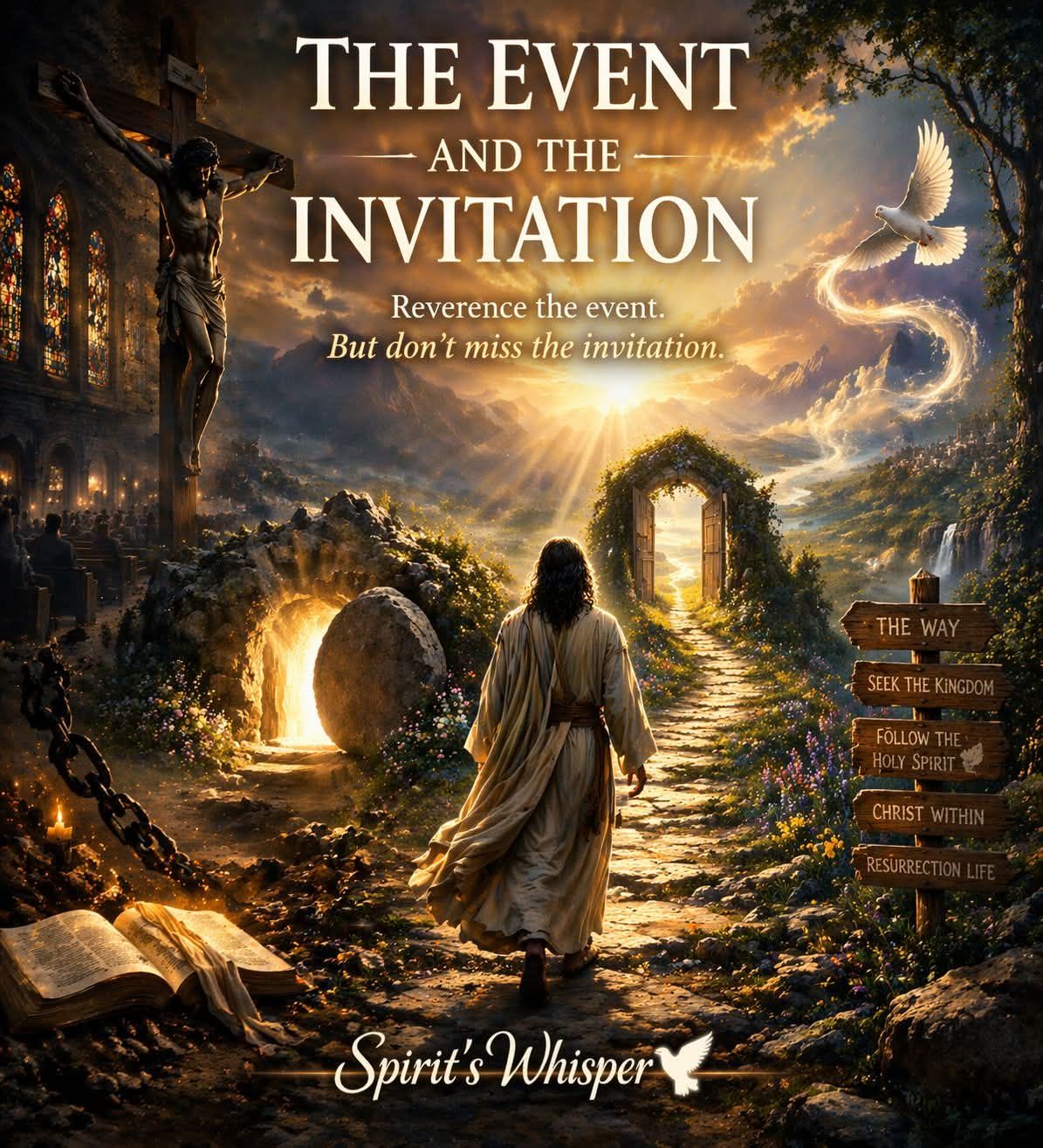
I reverence the event.
But I also believe many have stopped at the event without entering the invitation.
That is where much of Christianity has remained:
honoring what happened,
while refusing the way it was meant to open within us.
Even in the Acts of John, there is this mystery:
some see one thing, while another is shown something deeper.
That matters.
Because the historical event is real,
but it also carries a psychological and spiritual meaning that many never move into.
Jesus has not been hanging on a cross for 2,000 years, yet many still keep Him there in their minds.
You walk into churches and see Jesus still hanging on a cross.
You hear that the Father had to kill His own Son.
Yet Jesus said,
“I and the Father are one.”
So what does that do to the mind?
It creates a psychological divide.
It teaches people to imagine separation inside God Himself.
It teaches them to think the Father is against the Son, or that love must be satisfied by violence,
when Jesus was actually revealing the Father, not protecting us from Him.
And when little children are raised under that kind of imagery and theology without depth, without wisdom, and without the language of union and love, it can create fear, confusion, and inward fragmentation very early.
Jesus did not go around preaching,
“Believe that I will die and rise again,
and that is your access point.”
He preached the kingdom.
He taught the way.
He taught people to enter the secret place.
He taught them to seek first the kingdom.
He taught them not to live by anxious thought.
He taught them to follow the leading of the Holy Spirit.
And He said that if you love Him,
He would manifest Himself to you.
So my question is this:
why is so much of Christianity waiting on a future manifestation, while ignoring the manifestation He already spoke of?
Why are people waiting for a later return,
while neglecting the inward unveiling of Christ now?
The first followers were called followers of The Way.
Not because they merely agreed with an event,
but because they were being called into a pattern,
a path, a life, a union, a transformation.
Yeshua said,
“If you have seen Me, you have seen the Father.”
And that was not meant to stop with Him alone as an unreachable example.
It was an invitation into embodied union.
The same life.
The same love.
The same image revealed.
So yes,
reverence the event.
But do not stop there.
Because if Christ is in you,
then the call is not only to admire Him,
but to walk as He walked.
And when people see us,
they should encounter the fragrance of the Father.
That once sounded blasphemous to me at one time.
Now it sounds like the invitation.
And this is where religion often turns on people.
The same people who call themselves brothers and sisters can become the quickest to cast you out when you begin speaking of union, inner manifestation, or the kingdom within.
Yet Jesus made it plain:
what you do to the least of these,
you do to Him.
People still do not understand how interconnected all of this is.
The breath in every person is of God.
All things are of God.
To the pure, all things are pure.
All things were made through Christ, for Christ, and in Christ.
So when people speak of separation from an omnipresent God,
or of a literal physical hell for a spirit-being,
it reveals how externalized the whole thing has become.
Many have had experiences,
but then filtered those experiences through inherited theology, fear, separation, and tradition.
And then they call that truth.
But I can tell you this:
When I encountered the Father,
I did not meet the judgment I was taught to expect.
I was met with love.
He did not ask me,
“Did you believe the right formula?”
He did not ask me,
“Did you hold the right doctrinal statement about My Son?”
What I was met with was love.
And the words that remain with me are these:
“I have always loved you.
I’m just glad you started loving yourself.”
That does not make Jesus less real.
It makes His message more alive.
Because the goal was never merely to convince you of a past event.
The goal was to bring you into the kingdom.
Into union.
Into truth.
Into embodiment.
Into the living Christ.
So yes,
remember the cross.
But do not keep Him on it.
Remember the resurrection.
But do not leave it as history alone.
Enter the way.
Seek the kingdom.
Follow the instructions.
Let Christ manifest within you.
That is where the gospel becomes alive.
Reverence the event,
but do not miss the invitation.
The cross was not only to be remembered.
It was to open the way within.
 Grace Watcher Network
You must be logged in to post a comment.