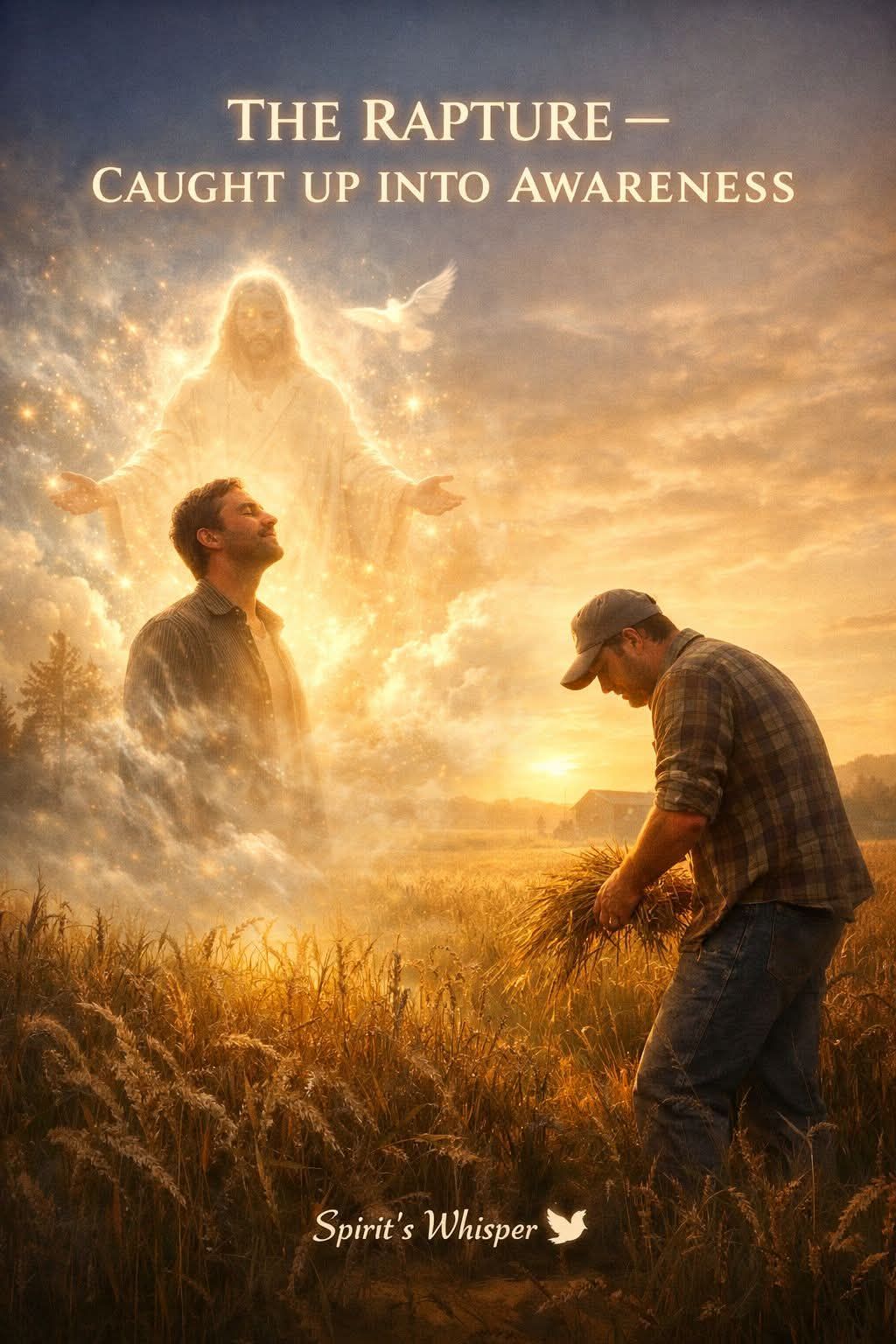
(1 Thessalonians 4:17)
“Then we who are alive and remain
shall be caught up together with them in the clouds to meet the Lord in the air…”
This verse has been turned
into one of the most feared
and misunderstood ideas in modern Christianity.
A sudden disappearance.
A mass evacuation.
A vanishing of bodies into the sky.
But what if that was never the point?
Let’s slow down…
and read it the way it was written.
“Caught up”
comes from the Greek word “harpazō.”
It means to seize,
to carry off,
to take by force…
but not necessarily physically.
It is used throughout Scripture
to describe being overtaken by something.
Overtaken by revelation.
Overtaken by Spirit.
Overtaken by a reality
that interrupts your current state.
Paul is not describing
people flying into outer space.
He is describing
a shift of awareness.
Now look at the next part:
“in the clouds…”
Clouds, throughout Scripture,
are never just weather patterns.
They represent the unseen realm,
the presence of God,
the place where form dissolves into mystery.
A cloud covered Sinai.
A cloud filled the temple.
A cloud received Yeshua from their sight.
Hebrews even says:
“We are surrounded by a great cloud of witnesses.”
Not floating spectators…
but a realm of awareness,
a collective of those awakened
to the reality of God.
Now…
“to meet the Lord in the air.”
The word “air” here is “aēr.”
It doesn’t mean outer space.
It means the atmosphere,
the invisible realm surrounding you.
The same space your breath moves through.
The same realm your thoughts move through.
The unseen environment
you are already living in.
So what is Paul describing?
A people…
who are alive and remain
(not just physically alive,
but spiritually awake)
being suddenly seized…
into awareness…
of the ever-present Christ.
Not leaving the earth.
But seeing through it.
Not escaping creation.
But perceiving the One within it.
Now tie this with what Yeshua said:
“Two will be in the field;
one will be taken and the other left.
Two will be grinding at the mill;
one will be taken and the other left.”
This has also been taught
as a physical disappearance.
But look closer…
They are in the same field.
Doing the same work.
Standing in the same place.
Yet one is “taken”…
and one is “left.”
Taken where?
Not into the sky…
but into awareness.
One is overtaken
by revelation.
The other remains
in the same place…
but without seeing.
Nothing changed externally.
Everything changed internally.
The “field” is life itself.
The “work” is your daily existence.
The separation is not distance…
it is perception.
One is caught up
into the unseen reality of God.
The other stays bound
to what appears visible.
This is the same pattern
Paul is describing.
Those who are “caught up”
are those who perceive.
Those who are “left”
are those still looking outward.
Not abandoned…
just not yet awakened.
This is why Paul says elsewhere:
“God has raised us up
and seated us with Him
in heavenly places.”
Not later.
Not after death.
Now.
So what is the “rapture”?
It is not a future evacuation.
It is an awakening.
A moment…
when the veil lifts,
and you realize:
you were never separate.
The dead in Christ rising first?
That which was lifeless in you
coming alive.
The forgotten identity.
The buried truth.
The dormant awareness…
awakening.
And those who are “caught up”?
Those who remain present,
aware,
awake…
are overtaken by that same realization.
This isn’t about disappearance.
It’s about revelation.
Because you don’t go somewhere else
to meet the Lord.
You awaken to where He has always been.
“In Him we live,
and move,
and have our being.”
The carnal mind
waits for escape.
The awakened heart
recognizes union.
So the question isn’t:
“When will you be taken?”
The question is:
Are you seeing…
or only looking?
Because the “air”
you are meant to meet Him in…
has always been within you.
The field has always been full…
but not all eyes are open.
Some are taken into seeing…
others remain in appearance.
You are not waiting to leave—
you are being invited to awaken.
 Grace Watcher Network
You must be logged in to post a comment.