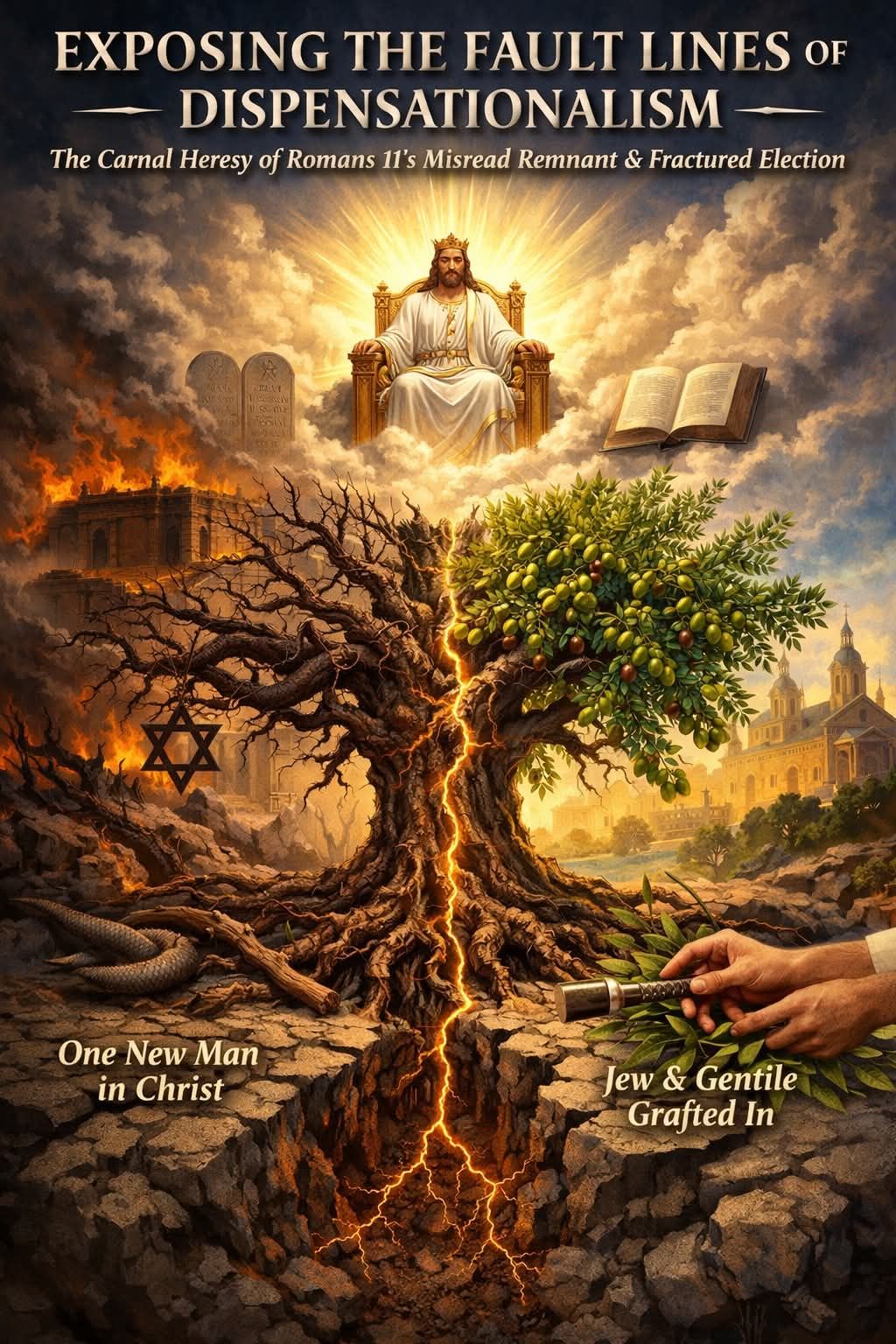
Misread Remnant and Fractured Election
Romans 11, the Olive Tree, and the Unity of God’s People
Dispensational premillennialism misreads Romans 11 in ways that fracture the unity of God’s covenant people. By turning the remnant of grace into a future ethnic program, it shifts the focus from faith in Christ to national identity and postpones promises already fulfilled in His reign.
Scripture declares that Christ is already enthroned:
He raised Him from the dead and seated Him at His right hand in the heavenly places, far above all rule and authority and power and dominion… and put all things under His feet and gave Him as head over all things to the church, which is His body (Ephesians 1:20–23).
From heaven’s throne, Christ reigns now.
This present dominion dismantles every system that:
Redefines “Israel” to preserve a future ethnic program
Divides the election into spiritual and ethnic categories
Delays covenant fulfilment to a future millennial age
There is one body.
There is one olive tree.
There is one people of God in Christ.
I. The One Olive Tree, One Covenant People
Romans 11 presents a single covenant tree:
Natural branches remain by faith
Wild branches are grafted in by faith
Unbelief breaks off any branch without ethnic exception
The defining mark of God’s people is not ancestry, but grace through faith.
The remnant principle runs through Scripture:
A faithful line preserved by grace
Promise fulfilled in Christ, the true Seed
Jew and Gentile united in Him
Paul himself proves this continuity: an Israelite saved not by ethnicity, but by grace.
II. “Beloved for the Fathers’ Sakes” Covenant Faith, Not Ethnic Privilege
Romans 11:28–29 is often used to claim unconditional ethnic favour. But the context rejects that idea.
Who are “they”?
They are hardened in unbelief regarding the gospel, yet “beloved” in relation to election.
Scripture never teaches saving love apart from faith. God’s covenant love flows through His redemptive promise, ALL fulfilled in Christ.
The fathers themselves lived by faith.
Abraham, Isaac, and Jacob trusted God’s promise. Their legacy is not biological entitlement but covenant faith.
The calling is irrevocable because it is secured in Christ.
Election is not divided between flesh and Spirit. There is one covenant, one people, one Saviour.
III. “Shall Be Grafted In” Present Opportunity, Not Future Nationalism
Paul’s warning is immediate, not distant.
Regrafting depends on faith, not ethnicity
God was already regrafting Jews in Paul’s day
The appeal was urgent, not millennia away
The olive tree remains one. No separate ethnic destiny is introduced.
IV. “All Israel Shall Be Saved” The Manner of Salvation
“And so all Israel shall be saved” describes how, not merely when.
Through:
Israel’s partial hardening
Gentile inclusion
One unified people formed in Christ
“All Israel” refers to the full covenant community (The Israel of God), the complete elect, Jew and Gentile together.
This is not redefinition, but fulfilment:
Strangers brought near
One household
One redeemed people
Faith unites.
Unbelief separates.
Ethnicity guarantees nothing.
V. AD 70 The Covenant Turning Point
The destruction of the temple marked the end of the old covenant order.
The shadow gave way to substance.
The earthly system ended.
Christ’s heavenly ministry remained.
From that point forward:
Access is through Christ alone
The remnant stands as the true covenant people
The dividing structures are gone
VI. What This Critique Addresses
Dispensationalism, as you see it, introduces several tensions:
Dividing God’s people into separate destinies
Elevating ethnicity beyond faith
Postponing fulfilment already accomplished
Recasting “Israel” primarily in national terms
Minimising the present reign of Christ
Conclusion: The Unity That Stands in Christ
Romans 11 proclaims one single covenant tree rooted in promise and sustained by grace.
Christ has come.
The Deliverer has acted.
The new covenant stands.
All who believe Jew and Gentile alike share:
One Lord
One faith
One baptism
One body
The gospel does not create parallel people. It creates one redeemed family.
Standing firm in that unity means holding truth with clarity, conviction, and grace proclaiming Christ’s finished work and present reign without returning to divisions the cross has already overcome.
 Grace Watcher Network
You must be logged in to post a comment.